Most people buy a stand mixer the way they buy a blender: by the bowl and the color. Then they get it home, load it with a stiff sourdough, and listen to the motor change pitch at minute three. Choosing a stand mixer for bread dough is not a capacity decision and it is not a brand decision. It is a torque decision, and the box almost never prints the number that actually matters.
I have spent twenty years with my hands in dough, ten of them running a bakery, and the rest teaching bread classes in Burlington, Vermont. In that time I have learned one thing about mixers: they rarely die on cake. They die on bread. A machine that whips cream like a dream can still stall on a two pound loaf, and the owner never sees it coming because nothing on the packaging warned them.
So this guide is narrow on purpose. It covers the two machines I would shortlist for home bread bakers, what to check before you buy either one, and the workflow I use to knead in a mixer without cooking the motor or overworking the dough.
Why you should trust me
I kneaded by hand until my wrists gave out, which is how most bakers discover the stand mixer in the first place. Before that I ran a bakery for a decade, which means I have watched commercial mixers and home mixers fail in the same way: not with a bang, but with a hot smell and a slow loss of speed under load.
My test for any mixer is not a cake mix and it is not a batch of whipped cream. It is a stiff dough, kneaded for a full ten minutes, followed by the only question that matters: what does the motor smell like afterward. I own three mixers, including a cheap one I bought specifically to see if it was worth hating. It was.
That is the lens for everything below. Not which mixer looks best on a counter, but which one is still turning dough in year five.
What actually matters before you spend a dollar
Wattage is a floor, not a promise. Wattage tells you how much power the motor draws, not how much twisting force it delivers to the hook. A 900 watt motor with poor gearing can feel weaker than a smaller motor with good gearing. Still, wattage is the only number most manufacturers give you, so use it as a screen: anything under 500 watts is a whipping machine with a dough hook accessory, not a bread machine. If you plan on stiff doughs or double batches, look higher.
Bowl capacity is a lie for dough. A bowl rated at several quarts of cake batter holds far less bread dough, because dough is dense and it climbs. Manufacturers quote the bowl's volume, not its dough capacity, and the gap between the two is where most disappointment lives. A mixer that handles a big bowl of frosting with room to spare may be genuinely unhappy with two pounds of bread dough.
Tilt head versus lift bowl. For bread people, a lift bowl design is sturdier. The bowl locks into a frame and stays put while the hook works. A tilt head moves the whole motor head out of the way to load, which is convenient for cakes and cookies, but under stiff dough the head is the part that can rock. Neither design is broken. One is simply built for heavier work.
The dough hook matters more than the marketing. A good spiral hook climbs the dough and kneads it against the bowl. A bad one buries itself in the center and spins while the dough sits still, which is a great way to heat up a motor while accomplishing nothing. Look at the hook shape before you look at the color options.
The smell test is the real spec. If a motor smells hot after ten minutes of dough, it is not powerful enough for what you bought it for. That is not a defect. That is the machine telling you the truth about its class.
How to size the mixer to your actual baking
Work backward from your loaves, not forward from the sale price.
Step one: count your typical batch. One loaf a week is a different machine than three loaves plus a tray of cinnamon rolls on Saturday. Be honest, because the machine you buy for the batch you wish you made is the machine that sits in the cupboard.
Step two: weigh your flour, not your bowl. A single lean dough at around 500 grams of flour is a modest load. A double batch pushes past what a small bowl can knead properly, no matter what the box claims about capacity.
Step three: check the wattage against your dough type. Soft enriched doughs are forgiving. Stiff, low-hydration doughs and heavy rye are not. If your regular bake is bagels or a tight sourdough, buy above the minimum.
Step four: decide where it lives. A heavy machine that stays on the counter gets used. A heavy machine that has to be lifted out of a low cupboard gets resented. That sounds like a lifestyle question, but it is a baking question, because the best mixer is the one you actually set up.
Step five: check the attachment ecosystem only after the motor. Attachments are wonderful and they are also how people talk themselves into an underpowered machine. The motor is the mixer. Everything else is a bonus you can add later.
The two mixers I would shortlist
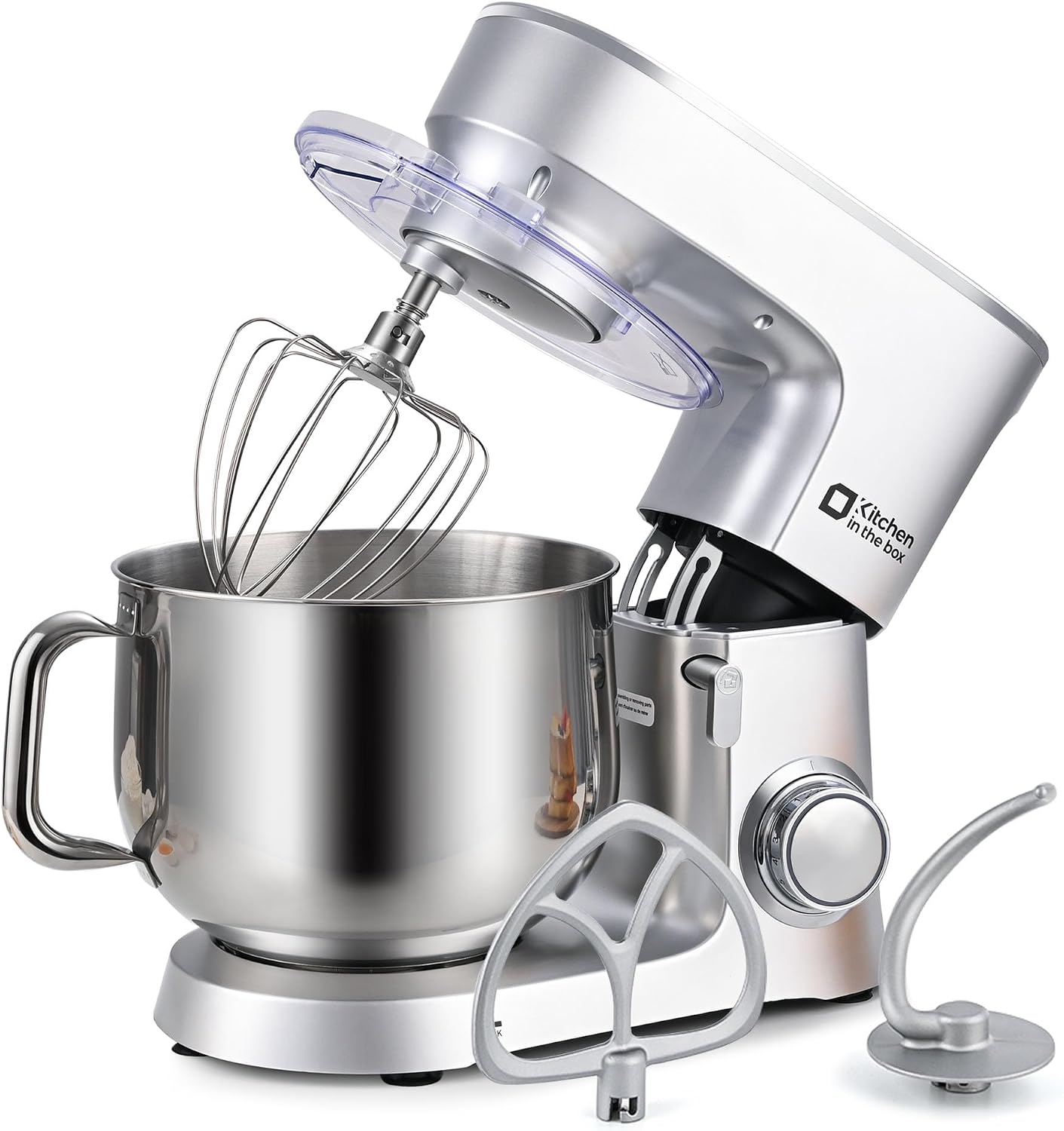
Best for big batches and stiff dough: Kitchen in the box Stand Mixer 8.5 QT, 900 Watt Heavy Dough Mixer Silver
 Visit on Amazon →
This is the machine for the baker who makes bread in quantity. A 900 watt motor paired with an 8.5 quart bowl is a lot of mixer for a home kitchen, and that is exactly the point. The name says heavy dough mixer, and the combination of that wattage and that bowl size is aimed at the job that kills smaller machines: a double batch of stiff dough that needs to knead for ten minutes without the motor fading.
The bowl size is the real story here. When you are mixing two or three loaves at once, or a big batch of brioche, or enough cinnamon roll dough to fill two pans, you want the dough to have somewhere to go. A crowded bowl means the hook cannot do its job, and the dough just spins. Extra capacity is not vanity. It is working room.
Flaws but not dealbreakers: This is a big machine, and it takes up counter space you may not have. The bowl is also large enough that a single small loaf can sit low in it, away from the hook's sweet spot, so if most of your baking is one loaf at a time you are paying for capacity you will not use every week.
Anyone who bakes in batches, feeds a household, or regularly doubles a recipe should look here first.
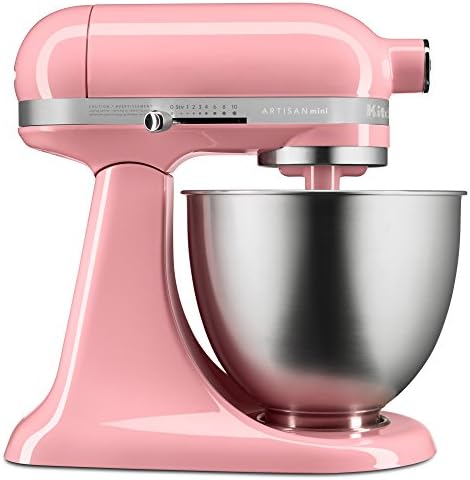
Best for small kitchens and single loaves: KitchenAid KSM3311XAQ Artisan Mini Series Tilt-Head Stand Mixer, 3.5 quart, Aqua Sky Blue
 Visit on Amazon →
The Artisan Mini is the opposite bet, and for a lot of kitchens it is the smarter one. A 3.5 quart bowl and a tilt head design make this a compact machine that can live on the counter under a cabinet without dominating the room. For someone who bakes a loaf a week, mixes pancake batter on Sunday, and wants one appliance that does all of it, this is the shape that fits real life.
It is also the machine that taught me the difference between a cake mixer and a bread mixer. It will knead bread. It just wants you to respect its size. Keep batches modest, keep the dough on the softer side of your usual hydration, and it will do the work. Push a stiff double batch through it and you will find the ceiling fast.
Flaws but not dealbreakers: The tilt head design means the head is the part that moves, so under a very stiff dough you may see it work. That is normal for this class of mixer, but it is a reason not to walk away for ten minutes with a heavy load. Keep an eye on it, and keep your batches honest.
Anyone in a small apartment, anyone who bakes in single loaves, and anyone who wants the mixer to stay out on the counter will get the most out of this one.
The actual workflow for kneading bread in a stand mixer
This works on either machine. Adjust the batch size, not the method.
Step one: start with the hook, not the paddle. Some bakers mix the shaggy stage with a paddle and then switch. You can, but you are adding a step and a dirty dish. The hook will bring the dough together if you let it.
Step two: hold back some water. Reserve roughly a tenth of your water and add it only if the dough looks dry after two minutes. Dough hydration is a moving target, and a mixer gives you less feel for it than your hands do, so give yourself room to adjust.
Step three: add flour gradually, not all at once. Dump it all in and you get a stiff mass the hook has to fight. Add most of it, let the dough come together, then decide if the rest is needed.
Step four: stay on low speed. Speeds one and two on most mixers are kneading speeds. Higher speeds do not knead faster, they just heat the dough and stress the motor. If your mixer has a dough setting, use it.
Step five: watch the first ninety seconds. This is where you learn what your machine can do. Does the dough move around the bowl, or does it sit in one spot while the hook spins inside it? Movement is good. A stationary lump is a warning.
Step six: let the dough climb the hook. A proper spiral hook pulls dough up and folds it back down. If your dough is clinging to the hook and stretching, the kneading is working. If it is puddled at the bottom, add a spoonful of flour and give it another minute.
Step seven: time it. Most lean doughs need somewhere around six to ten minutes in a mixer to reach full development. Enriched doughs take longer because the fat slows gluten formation. Do not time by the clock alone.
Step eight: do the windowpane test. Pull off a small piece and stretch it thin enough to see light through it. If it tears, keep kneading. If it stretches translucent without tearing, you are done.
Step nine: rest the motor if it smells hot. Stop, unplug it, and let it cool. A mixer that smells hot is not necessarily broken, but it is telling you the load is at the top of its range. Next time, split the batch.
Mistakes that kill mixers early
Kneading cold dough straight from the refrigerator is the fastest way to strain a motor, because cold dough is stiff dough. Let your ingredients come to room temperature.
Doubling a recipe in a bowl that cannot take it is the second fastest. A crowded bowl means the hook cannot fold the dough, so it just churns and heats.
Running dough on speed four is the third. High speed does not develop gluten faster. It develops heat faster.
And ignoring the smell is the last one. Motors do not usually fail without warning. They give you a warning you can smell, and most people keep going.
What this all costs
Both machines are in a similar range for a home baker, and both are far cheaper than replacing a burnt out mixer every two years. Check current Amazon price on each and do the math against your own baking.
The honest calculation is cost per loaf. A mixer that survives a decade of weekly bread costs you very little per bake. A mixer that stalls, smells hot, and dies in year two costs you the purchase price plus the annoyance of shopping again. That is the whole argument for buying above the minimum.
The bottom line
Buy the motor, not the bowl. If you bake in batches and your dough runs stiff, the Kitchen in the box 8.5 quart, 900 watt machine gives you the working room and the power to knead without drama. If you bake a loaf at a time in a small kitchen and want the mixer to live on the counter, the KitchenAid Artisan Mini is the compact choice, as long as you keep your batches within its limits.
Either way, knead on low, watch the first ninety seconds, and trust your nose. If the motor smells hot after ten minutes of dough, you have your answer about what that machine is for.