Most stand mixers for bread dough are sold on bowl size, and bowl size is the least useful number on the box. A 5-quart bowl tells you how much batter fits before it climbs the beater, and nothing about whether the motor will hold speed once a stiff dough tightens up and starts fighting back. The question that actually decides whether you are happy in year three is simpler: what kind of baking happens in your kitchen every week, and does the machine's design match it?
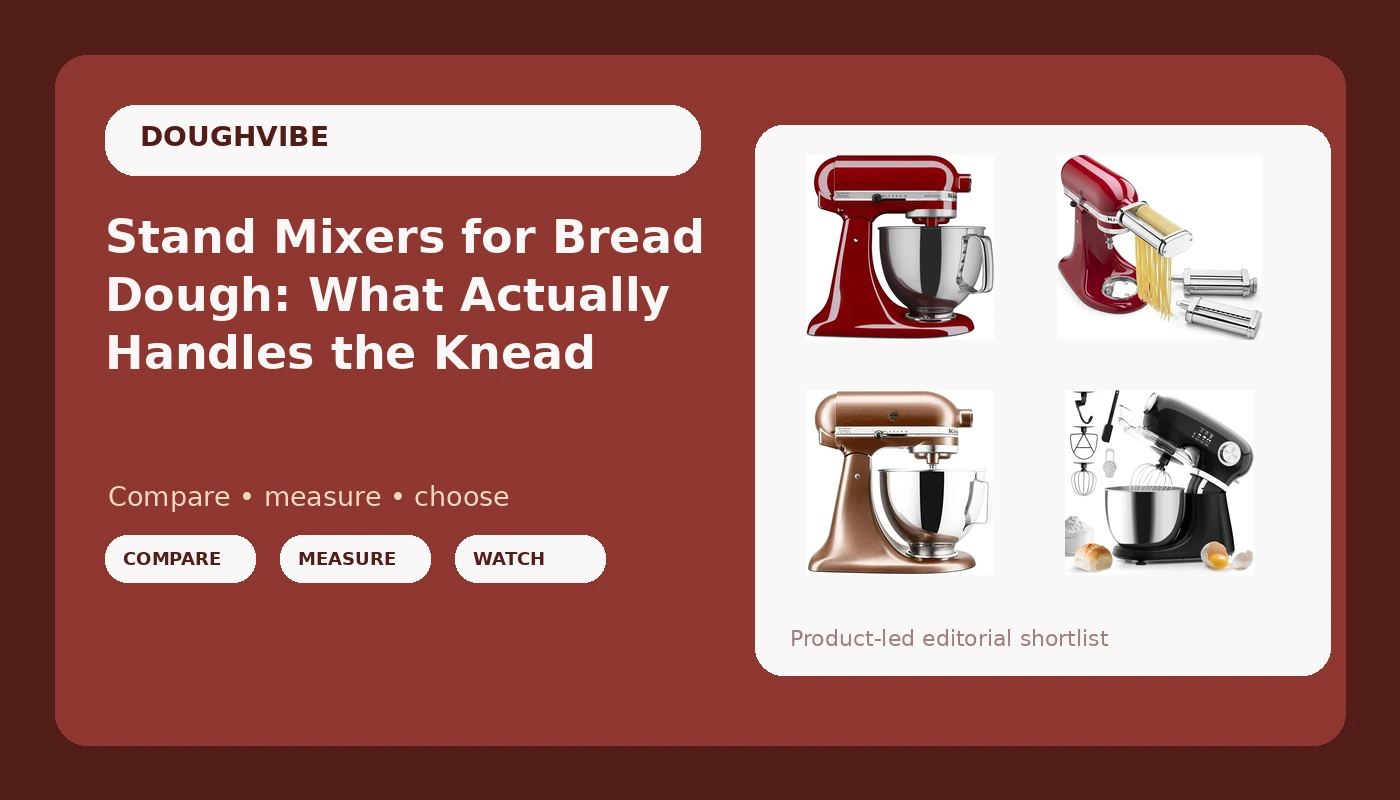
The four products below cover the realistic paths a home baker takes. A long-running tilt head all-rounder with the deepest attachment ecosystem, a pasta roller and cutter set that turns a compatible mixer into a system, a smaller-bowl classic for modest batches and short counters, and a budget machine for lighter duty. Each one solves a different problem, and the trade-offs are worth naming out loud before you buy.
Related: Tilt Head vs Lift Bowl: Which Stand Mixer Design Holds Up →
Quick answer
For one machine that mixes, whips, and kneads ordinary home batches, the KitchenAid Artisan 5-Qt tilt head is the safest default, and its attachment hub is what keeps it useful for years. If pasta is the goal and you already own a compatible KitchenAid mixer, the KSMPRA 3-piece roller and cutter set extends that mixer instead of replacing it. If your batches are smaller or your counter space is tight, the 4.5-quart KitchenAid Classic covers the same everyday jobs in a smaller bowl. If budget is the deciding constraint and your doughs stay moderate, the Electactic 5.3 Quart is the entry point. None of these is automatically better than the others, because they answer different constraints. Check current Amazon price on each before you commit.
Four useful options
| Model | Best fit | What stands out |
|---|---|---|
| KitchenAid Artisan, 5-Qt Tilt Head Stand Mixer, KSM150PS, Empire Red | All-purpose home baking and everyday doughs | 5-quart tilt head bowl and broad compatibility with KitchenAid hub attachments |
| KitchenAid KSMPRA 3-pc Pasta Roller/Cutter Set for KitchenAid Stand Mixers | Fresh pasta on a mixer you already own | Three pieces that mount on a compatible KitchenAid attachment hub |
| KitchenAid Classic 4.5 Quart, 10 Speed, Tilt Head Stand Mixer, Copper | Smaller batches and compact kitchens | 4.5-quart tilt head bowl with a 10-speed control |
| Electactic 5.3 Quart Electric Stand Mixer With 12 Speed, Low Noise | First mixer or lighter-duty mixing | 5.3-quart bowl, 12-speed control, and a low-noise design |
The all-rounder: KitchenAid Artisan, 5-Qt Tilt Head Stand Mixer, KSM150PS, Empire Red
This is the mixer most people picture when they picture a stand mixer, and that familiarity is part of the argument for it. A 5-quart bowl handles a standard two-loaf bread batch or a double batch of cookie dough without a bowl change, and the tilt head lifts clear so you can scrape down the sides and add flour without wrestling the beater out of the way. Where it earns its keep over a decade is the hub at the front: the KitchenAid attachment line is designed to mount there, which means the mixer can grow into jobs you have not planned yet.
The trade-off is honest and worth stating. This is a home machine, and a stiff, low-hydration dough will make it work harder and longer than a bowl-lift design with a heavier drivetrain. A 70 percent hydration sourdough is comfortable territory. Bagel dough every weekend is asking a lot, and you will feel it in the housing and hear it in the motor.
The system extender: KitchenAid KSMPRA 3-pc Pasta Roller/Cutter Set for KitchenAid Stand Mixers
This is the one product here that is not a mixer at all, and that is the point. The set adds a roller and cutters that mount on a KitchenAid stand mixer's attachment hub, so a machine already sitting on your counter can sheet pasta dough to a consistent thickness instead of you leaning across the counter with a rolling pin. The practical case is consistency and volume: fresh pasta for four is a chore by hand and a routine by roller, and sheets that come off even are the difference between clean ribbons and ragged ones.
The trade-off is dependency. It only makes sense if you already own a compatible KitchenAid mixer, and it will not fit a mixer whose hub is a different design. If pasta is a twice-a-year project, that money is better spent on the mixer itself. Buy this as an extension of a system you already have, not as a starting point.
The compact classic: KitchenAid Classic 4.5 Quart, 10 Speed, Tilt Head Stand Mixer, Copper
The Classic is the smaller sibling in the KitchenAid tilt head family, and the 4.5-quart bowl changes who it suits. A single loaf, one cake, a batch of muffins, a bowl of whipped cream: this is the size of baking most households actually do, and a smaller bowl means less headroom wasted and less bulk on a short counter. Ten speeds give you a slow enough start to keep flour from flying and enough range to cream butter without splashing it up the sides.
The trade-off is batch size. If you routinely double a bread recipe or make a big batch of rolls for a holiday, a 4.5-quart bowl fills faster than you expect, and you end up mixing in stages, which is both slower and harder on the motor. Tilt head convenience also comes with a little more movement under a heavy load than a bowl-lift design, so if your weekly bake is a stiff dough at scale, this is not the bowl to do it in.
The budget entry: Electactic 5.3 Quart Electric Stand Mixer With 12 Speed, Low Noise
At this end of the market, the honest framing is that you are buying a machine for mixing, whipping, and moderate kneading, not for a decade of weekly bread at scale. The 5.3-quart bowl is generous for the price tier, the 12-speed control gives you fine gradations to work with, and the low-noise design matters more than it sounds if your kitchen opens into a living space. For cakes, cookies, quick breads, frosting, and the occasional pizza dough, that combination covers a lot of ground.
The trade-off is motor class. Budget mixers show their limits on stiff, low-hydration dough, and the signal is heat and slowing rather than a dramatic failure. Treat bread as a moderate-hydration job, mix in stages, and give the machine breaks, and it will do what you need. Expect it to knead bagel dough the way a heavier machine does and you will be disappointed.
Prices and availability may change. Product images, names, and retailer links are matched to verified listings. No current price, rating, stock status, or measured result is stated here without current evidence.
Bowl size, wattage, and torque: which number matters
Wattage is the number printed largest and understood least. It describes how much power the machine draws from the wall, not how much twisting force reaches the dough hook. Torque is what actually kneads: the force the drivetrain can keep applying when a stiff dough resists. Two mixers with identical wattage ratings can behave completely differently on the same two-pound loaf, because gearing, motor design, and how the machine manages heat all sit between the wall outlet and the hook.
Bowl capacity has the same problem. A 5-quart bowl is a volume measurement for batter, and dough is a different material. Dough that has tightened up is dense and heavy, and it loads the motor in a way that cake batter never does. This is why a mixer can whip cream effortlessly and then stall on bread: whipping is a light, high-speed job, and kneading is a slow, high-load job. They are not the same test, and a machine that passes one is not automatically good at the other.
The practical signal of an overworked mixer is not a bang. It is heat in the housing, a motor that audibly slows when the dough tightens, and a machine that needs longer and longer to finish the same knead. If you notice any of those, you are past what the mixer was built for, and the fix is a smaller batch, a wetter dough, or a heavier machine.
Tilt head or lift bowl, and where attachments fit
Tilt head mixers raise the head so the bowl stays put. That is convenient for scraping, adding ingredients, and swapping the beater for the dough hook, and it is why most home kitchens end up with one. The trade-off is stability: the head is a moving part, and a moving part can shift under a heavy load. Bowl-lift mixers raise the bowl into a fixed head instead, which makes the bowl mounting more rigid and the whole machine steadier when dough is fighting the hook. For bread at volume, that rigidity is the reason bowl-lift designs exist.
Attachments are the other half of the decision, and they are where the long-term value sits. A mixer with a standard attachment hub can take a pasta roller, a grinder, or a shredder, which means one motor on the counter does several jobs. A mixer without that ecosystem is limited to mixing, no matter how many speeds its dial offers. If you are considering the KSMPRA pasta set above, confirm that your mixer's hub accepts it before buying, because the set is designed specifically for KitchenAid stand mixers.
Here is the order I would work through before spending money:
- Write down what you bake in a normal month, not what you might bake someday.
- Identify your stiffest dough and its batch size, since that sets the minimum motor class you need.
- Decide whether the attachment hub matters to you, because it determines whether the mixer is a gadget or a system.
- Match bowl size to your real batch size rather than to the biggest recipe you have ever seen.
- Set your budget by motor class and drivetrain, not by the number of speeds on the dial.
Practical guidance for getting more out of any mixer
- Weigh flour instead of scooping it, so hydration stays consistent and the load on the motor is predictable from batch to batch.
- Add flour gradually and let the dough come together before you push the machine, rather than dropping a solid mass onto the hook.
- Let the dough hook climb the dough instead of holding it down, since a hook that grips and lifts is doing the kneading work for you.
- Rest the dough for 15 to 20 minutes after mixing, which lets hydration and gluten development reduce how much mechanical work the mixer has to do.
- Feel the housing during long kneads. Warm is normal on a heavy job; hot is the machine telling you the batch is too big or too stiff.
- Decide whether pasta, grinding, or shredding is a real habit before you buy attachments, because unused attachments are the most expensive thing in the cupboard.
Which option should you choose?
Choose the KitchenAid Artisan, 5-Qt Tilt Head Stand Mixer, KSM150PS, Empire Red when you want one machine that covers mixing, whipping, and ordinary bread batches, and you want the attachment ecosystem that lets it take on pasta and other jobs later. Choose the KitchenAid KSMPRA 3-pc Pasta Roller/Cutter Set when you already own a compatible KitchenAid mixer and fresh pasta is something you would make often if the rolling were easier. Choose the KitchenAid Classic 4.5 Quart, 10 Speed, Tilt Head Stand Mixer, Copper when your batches are small, your counter is short, and you bake a few times a week rather than in bulk. Choose the Electactic 5.3 Quart Electric Stand Mixer With 12 Speed, Low Noise when budget is the constraint, your doughs stay moderate in hydration, and quiet operation matters in your space.
One caveat applies to all four. The specifications here come from the product listings, not from a lab, and dough performance depends on hydration, batch size, flour, and room temperature as much as on the machine. A mixer that handles your sourdough comfortably can still struggle with a stiff bagel dough on a cold day. Confirm current details, compatibility, and price on each listing before you buy, and treat speed counts as a control feature rather than a measure of power.
The bottom line
The right stand mixer is the one whose motor class matches your stiffest regular dough and whose bowl matches your real batch size. For most home bakers, that points to the Artisan as the all-rounder, with the smaller Classic as a sensible choice when space and batch size are modest, and the Electactic as a reasonable entry if the budget is tight and the doughs are forgiving. The KSMPRA set is a different kind of purchase: it is the upgrade that makes an existing mixer earn more of its counter space. Buy for the baking you do most weeks, check the current price on the listing, and let the attachment hub and motor class guide you rather than the bowl size on the box.