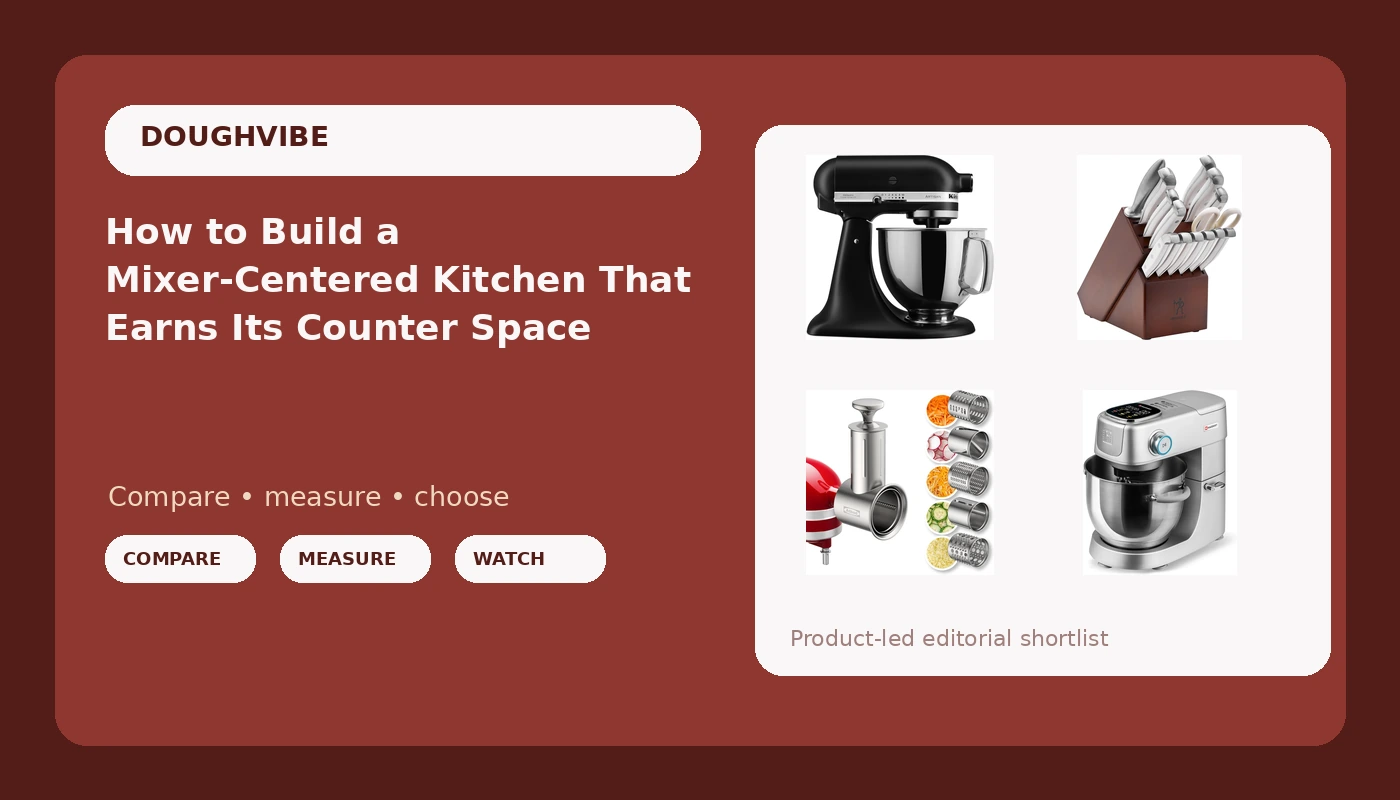
A stand mixer setup is never one purchase. It is a machine, an attachment or two, and the prep tools that feed the whole operation, and the order you buy them in shapes how much you actually bake. Twenty years of baking, including a decade running a bakery, taught me that most home bakers shop the wrong number first: they compare bowl sizes and finish colors, then discover in January that the machine stalls halfway through a stiff sourdough. The second mistake is quieter. Someone buys a capable mixer, never learns what the front hub does, and spends three years grating cheese by hand next to a machine built to do exactly that. This explainer covers four pieces that make a working stand mixer setup: two mixers aimed at different bakers, the slicer and shredder attachment that extends a KitchenAid into a prep station, and the knife set that handles everything a mixer cannot.
Related: What Motor Torque Actually Means for Bread Dough →
Quick answer
If you want one machine for cakes, cookies, and moderate bread duty, the KitchenAid Artisan 5-Qt Tilt Head is the conventional starting point, and its attachment hub is what makes that choice last. If your weekly baking runs toward large batches of stiff dough, the Hauswirt 6QT XL pairs a bigger bowl with an 11-speed, full metal build and a touch screen control panel. Add the stainless steel slicer shredder attachment if you own a KitchenAid mixer and want cheese, vegetables, and nuts handled at the counter. Add the Henckels Statement 15-piece set for the cutting work. Each one solves a different problem, and none of them replaces the others.
4 useful options
| Model | Best fit | What stands out |
|---|---|---|
| KitchenAid Artisan, 5-Qt Tilt Head Stand Mixer, KSM150PS, Black Matte | Cakes, cookies, and moderate bread batches | 5-quart tilt-head design inside the widest attachment ecosystem in the category |
| Stainless Steel Slicer Shredder Attachment for KitchenAid Stand Mixer | Cheese, vegetables, and nuts for KitchenAid owners | Five interchangeable blades and dishwasher-safe components |
| Hauswirt Stand Mixer 6QT XL Large | Larger batches and bakers who want more bowl | 6-quart bowl, full metal structure, 11 speeds, 4.5" LED touch screen |
| Henckels Statement 15-Pc Knife Set | Everyday chopping, slicing, and prep | 15 pieces, German engineered, white handle finish |
The all-rounder: KitchenAid Artisan, 5-Qt Tilt Head Stand Mixer, KSM150PS, Black Matte
The case for this machine is not that it does everything well. It is that it does the most things adequately and then stays useful for years, because the front hub turns it into a platform. A tilt head raises the motor out of the way so you can scrape the bowl without unhooking anything, which matters more than it sounds when you are adding flour in three stages. The trade-off is stiffness. Under a heavy dough the head is the part that moves, and a 5-quart bowl sets a real ceiling on batch size. If your weekly bake is two loaves and a tray of cookies, that ceiling never bothers you. If it is four loaves, it will.
The attachment: Stainless Steel Slicer Shredder Attachment for KitchenAid Stand Mixer
This is the piece that changes how often the mixer leaves the cupboard. A block of cheese, a bag of carrots, a pile of nuts: all of it goes through the hub while the motor does the work, and the blades go in the dishwasher afterward. The catch is compatibility. It is built for KitchenAid mixers, so it is not a purchase for a Hauswirt owner, and it is the kind of accessory that only pays off if you actually shred and slice at home. If you buy pre-shredded cheese and pre-cut vegetables, the attachment will sit in a drawer. If you buy blocks and heads of things, it earns its space in a month.
The alternative: Hauswirt Stand Mixer 6QT XL Large
The honest reason to consider this machine is bowl volume. Six quarts buys you a bigger batch before you split dough into two sessions, and the 11-speed range with a touch screen gives you finer control over slow incorporation than a simple dial. The trade-off runs the other way from the KitchenAid. You get more capacity and a modern control panel, and you give up the deep third-party attachment ecosystem, because that hub is a KitchenAid standard. Decide which of those two things you will notice more in year three, not in week one.
The prep side: Henckels Statement 15-Pc Knife Set
A mixer handles fat, sugar, and gluten. It does not portion butter, split a chicken, or cut a block of cold cheese down to a size the shredder drum can take. That is the gap this set fills, and it is worth naming because bakers who spend their whole budget on the mixer end up doing all of that with one dull paring knife. Fifteen pieces is more than most home cooks need, and a large set is a storage decision as much as a cutting one. If you have drawer or block space and want the whole range at once, the set covers it. If you cook with three knives, buy three knives.
Prices and availability may change. Product images, names, and retailer links are matched to verified listings. No current price, rating, stock status, or measured result is stated here without current evidence.
Why torque matters more than the number on the bowl
Wattage and torque are not the same thing, and the difference is where most mixer disappointments start. Wattage describes how much power the motor draws. Torque describes the twisting force it delivers to the dough hook, and torque is what decides whether a stiff dough gets kneaded or the machine just hums and heats up. A mixer can whip cream beautifully and still struggle the moment a two-pound loaf tightens up, because whipping and kneading ask completely different things of the same motor.
The practical test is not a spec sheet. It is what happens ten minutes into a stiff dough. If the bowl is warm, if the head is rocking, if the motor smells hot, the machine is working outside its comfortable range, and no bowl size will fix that. Bowl capacity is the other half of the same problem. A bowl is rated to its brim, but dough needs room to climb the hook and expand, so the usable capacity for bread is meaningfully smaller than the number on the box. A 5-quart mixer is not a 5-quart bread machine. A 6-quart mixer is not a 6-quart bread machine either, but it gives you more room before you have to split the batch.
This is also where the tilt-head versus lift-bowl question lives. A lift-bowl design raises the bowl into a fixed head, which is a sturdier arrangement under load. A tilt head moves the motor instead, which is easier to load and scrape but more prone to wobble when dough gets heavy. Neither is wrong. They are different answers to different bakers.
How the attachment port changes what a mixer can do
The single most underrated feature on a stand mixer is the hub on the front. A mixer with a live attachment ecosystem is not one appliance, it is a small system: a grinder, a pasta roller, a spiralizer, a slicer shredder. That is why the attachment choice matters as much as the mixer choice, and why buying a mixer with no ecosystem means buying a mixer you will eventually outgrow.
Here is the order I would work through before spending anything:
- Decide what your weekly bake actually is, not what you would like it to be.
- Estimate the largest single batch of dough you make, and check whether the bowl handles it without splitting.
- Check whether the mixer has an attachment hub, and what fits it.
- Match the attachment to prep you already do by hand, like shredding blocks of cheese or slicing vegetables.
- Budget for the knife work too, because no mixer portions, trims, or cuts.
What to check before you commit counter space
- Measure the counter and the cupboard before you fall in love with a finish. A stand mixer is heavy, and one that lives in a box gets used once a month.
- Think about the heaviest dough you make, not the lightest. The mixer only has to survive your worst Tuesday.
- Confirm attachment compatibility by brand, not by photo. Hubs are not universal.
- Check whether the accessories you want are dishwasher safe, because hand-washing a shredder drum gets old fast.
- Count your knives honestly. A 15-piece set is a bargain only if you have somewhere to put 15 pieces.
Which option should you choose?
Choose the KitchenAid Artisan, 5-Qt Tilt Head Stand Mixer, KSM150PS, Black Matte when you want one mixer for cakes, cookies, and moderate bread batches, and you expect to add attachments over time. Choose the Stainless Steel Slicer Shredder Attachment for KitchenAid Stand Mixer when you already own a KitchenAid mixer and you shred or slice by hand often enough to notice. Choose the Hauswirt Stand Mixer 6QT XL Large when bowl capacity and a touch screen control panel matter more to you than third-party attachment options. Choose the Henckels Statement 15-Pc Knife Set when the prep work around the mixer is the bottleneck, not the mixing itself.
One caveat applies to all four: the distinctions here come from manufacturer specifications and design category, not from a bench test of these specific units. Motor behavior under stiff dough varies by model and by how hard you push it, and the only reliable check is how the machine performs on your dough in your kitchen.
The bottom line
A stand mixer setup works when the pieces complement each other instead of duplicating each other. Start with the mixer that matches your real batch size and your real attachment plans, then extend it with an attachment that replaces hand prep you already do, then fill the gaps a mixer cannot cover with decent knives. Buy in that order and every purchase has a job on day one. Buy in the reverse order and you end up with a beautiful machine, a drawer of unused blades, and cheese you are still grating by hand.