Most people buy a mixer by reading the number on the box, then find out the number was never the problem. A working small stand mixer bread dough routine lives or dies on two things: how much dough you ask the motor to push, and how patiently you let it push. Get those right and a compact machine will turn out a loaf a week for years. Get them wrong and you will smell hot windings by the fourth batch and start shopping again.
I have been baking for 20 years, ran a bakery for a decade, and now teach bread classes in Burlington, Vermont. My wrists quit on hand kneading long before my interest in bread did. I have owned three mixers, including one cheap machine I bought specifically to find out whether it was worth hating. It was. What follows is the routine I hand to students who cook in apartments and small kitchens, where a big lift-bowl machine is more counter space than they own.
Why you should trust me
Twenty years at the bench, ten of them running a bakery where every loaf went out the door on my reputation, and now a teaching kitchen where the questions never change: will this machine knead bread, and how do I keep it alive? I bake weekly and teach weekly. I have spent enough hours next to a dough hook to know what a healthy knead sounds like and what a motor about to quit sounds like. My rule has not moved since the bakery days. No mixer gets called powerful until it has handled a stiff dough, and no mixer gets recommended until I know what the motor smells like after ten minutes of work. That rule is the spine of everything below.
What a small mixer can and cannot do
Direct answer first: yes, a compact mixer can knead bread. No, it cannot knead all bread.
The limiting factor is not the quart number on the box. It is torque, the twisting force that actually moves stiff dough. Wattage tells you how much power the motor draws, not whether it can push a dense lump of cold dough around a bowl without stalling. A small machine with well-geared torque will out-knead a larger machine with a weak motor, which is why bowl capacity marketing deserves every bit of the skepticism it gets.
What that means in a real kitchen:
- One loaf at a time. A compact bowl is a single-batch bowl. Doubling a recipe is how small mixers die.
- Stay inside the bowl's comfort zone. As a working rule, never let dough fill more than about half the bowl, because dough climbs and swells as it develops. A bowl packed to the rim has nowhere to put the expansion.
- Stiff dough is the real test. A soft, wet dough is a fair fight for almost any motor. A stiff dough is where a weak machine shows its hand, and if you insist on one, split it into two small batches and give the motor breaks between them.
- Whipping and kneading are different jobs. A machine that whips cream into peaks without breathing hard can still stall on bread. Never judge kneading power by how a mixer handles egg whites.
- Lightweight means you are part of the machine. Small mixers are portable, which is the point, but a light base wants to walk across the counter. Hold it, or put a damp towel underneath, and stay off the top speeds when dough is in the bowl.
One more thing about design. A lift-bowl machine raises the bowl into the head on arms, and that arrangement is a fortress under heavy dough. A tilt-head machine hinges at the back and can wobble when the load gets stiff. Most compact mixers are neither. They are lightweight helpers with a hook, and the honest way to treat one is as a helper: it does the first eight minutes of work so your hands do not have to.
The two tools that carry a small-kitchen bread day
You need one machine for the mixing and one set of blades for everything that happens after the bowl. The machine does the labor. The blades do the scoring, portioning, and slicing that finish the loaf.
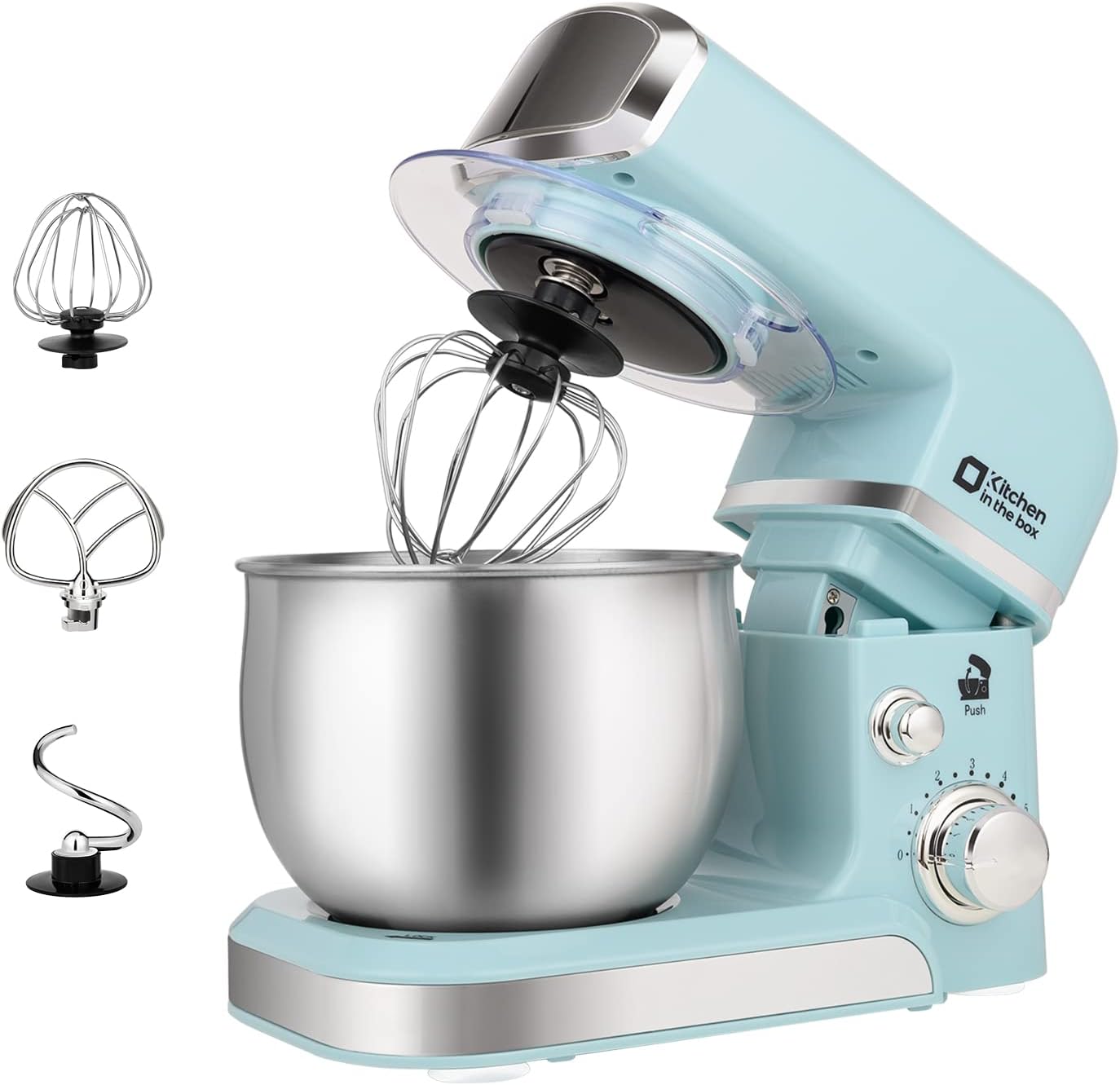
Budget pick: Kitchen in the box Stand Mixer,3.2Qt Small Electric Food Mixer,6 Speeds Portable Lightweight Kitchen Mixer for Daily Use with Egg Whisk,Dough Hook,Flat Beater
 Visit on Amazon →
This is the small-mixer entry point, and it comes with the three attachments a beginner actually uses: an egg whisk, a dough hook, and a flat beater. Six speeds give you the low end you want for bread and the upper range for cream, cake batter, and frosting, which means one machine covers most of what a small kitchen bakes. It is lightweight and portable, so it can live in a cabinet and come out on baking day instead of owning a permanent square of counter.
For bread, run it the way a compact machine wants to be run. One loaf per batch, low speeds only, and your hand on the base. The 3.2-quart bowl is a one-loaf bowl, and the dough hook is the attachment that decides whether you get bread or a workout. Check current Amazon price before you decide, because this class of mixer moves around a lot and the value changes with it.
Flaws but not dealbreakers: The light build is the trade-off for the light weight. It is not a machine you walk away from while stiff dough is kneading, and it is not built for double batches. Respect the batch size and it will keep working.
Anyone cooking in an apartment or a small kitchen who wants to make one loaf or one cake at a time should start here rather than with a heavy machine they will resent moving.
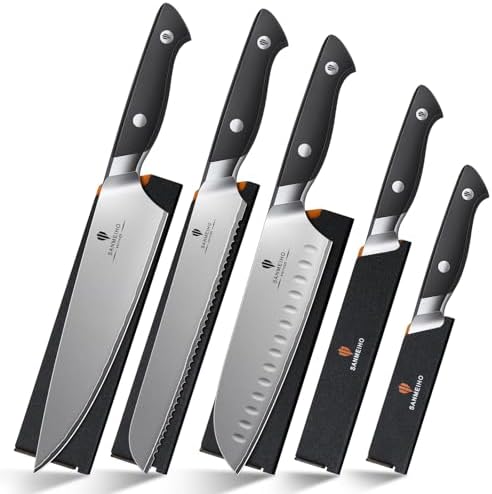
The bench set: 16 PCS Japanese Kitchen Knife Set with Block, Dishwasher Safe
 Visit on Amazon →
Bread does not finish in the mixer. It gets scored, portioned, and sliced by hand, and every one of those jobs wants a sharp edge. A 16-piece set with a block covers the scoring blade, the slicing blade, and the utility knives you will use on butter, cheese, and the sandwich that follows the loaf. The set is listed as dishwasher safe, which matters more on a baking day than most people admit, because the counter is already covered in flour and you are not looking for another sink full of dishes. Check current Amazon price before you commit to the block.
A mixer cannot score a loaf and a knife cannot knead one, which is exactly why these two tools belong in the same conversation. If you are building a bread kit from nothing, this is the half that outlives every appliance you buy.
Flaws but not dealbreakers: A block takes up counter space, and a set this size covers more cooking than bread alone. If you are tight on room, the block is the piece you have to make space for.
Anyone who cooks as well as bakes will get more out of a full set than out of one dedicated bread knife.
The workflow: kneading bread dough in a compact mixer
Here is the sequence I teach. It works with any hook-and-bowl machine, and it is built to protect a small motor.
Step one: size the batch to the bowl. One loaf, and no more than about half a bowl of dough once it is mixed. If your recipe makes two loaves, split it and knead in two passes with a rest in between.
Step two: autolyse before you knead. Stir the flour and water together with a spoon, with no salt and no yeast, until you have a shaggy mass. Cover it and let it sit 20 to 30 minutes. The flour hydrates and gluten starts forming with zero strain on the motor. The dough that goes into the bowl afterward is already cooperative, which means fewer minutes of kneading.
Step three: add salt and yeast, then mix on the lowest speed. Speed one or two, never higher, until the dough comes together. High speed on stiff dough is how motors burn and how light machines travel across a counter.
Step four: watch the hook, not the clock. A good dough hook gathers dough and climbs it. If the dough just wraps the hook and spins as one lump without stretching, it is either too dry or the batch is too big. Add water a tablespoon at a time, or take half the dough out.
Step five: scrape and touch. Stop every few minutes, scrape the bowl down, and put a hand on the dough. If the dough feels warm, or the bowl is warmer than when you started, friction is cooking your dough. Stop and let everything rest for ten minutes.
Step six: run the ten-minute smell test. After about ten minutes of kneading, lean in and smell the machine. Warm plastic is normal. A hot, electrical, almost burnt smell is not. That smell is your only warning before a motor quits. Stop, unplug, and let it cool for 15 minutes before you finish.
Step seven: finish by hand. Small mixers rarely take dough all the way to a windowpane. Turn it onto the counter and give it 20 to 30 turns by hand, or a few stretch-and-folds with a rest between. That last bit of gluten development costs you two minutes and saves the motor.
Step eight: rest, shape, score, bake. Bulk ferment, punch down, shape, and score the top with one clean, decisive cut. A sharp blade opens the loaf and gives the oven a place to expand into. A dull, sawing motion deflates everything you just built, which is the whole reason the bench set above matters as much as the mixer.
How long does it all take? Plan on 8 to 12 minutes of machine time for a single loaf, plus the autolyse rest and the cooling breaks. If a recipe tells you to knead for 20 minutes in a compact mixer, the recipe was written for a bigger machine.
When a small mixer is not the right answer
If you bake more than two loaves a week, if you want bagels and pizza dough on the same day, or if you keep trying to double batches, a compact mixer is the wrong tool and no technique will fix it. The next tier is a heavier machine with real torque and a bowl that locks into arms instead of hinging at the back, because lift-bowl designs stay steady when the dough fights back. Above that sit the big-bowl European roller mixers, which handle stiff dough in a way no hook-and-bowl machine does, at a price and a footprint that only makes sense if bread is a serious weekly habit.
Buy that tier when your baking volume demands it. Do not buy it because a box said five quarts, because a five-quart bowl that stalls on two pounds of dough is a marketing problem, not a bread machine.
What it really costs
The number that matters is not the sticker. It is cost per loaf over the life of the machine. A mixer that survives a decade of weekly baking costs less per loaf than one you replace in year two, and the math gets better every year you keep it. That is the entire argument for buying a machine sized to your real baking, not to a fantasy of holiday baking you do twice a year.
The other half of the cost is time. Twenty minutes of hand kneading a week is 17 hours a year, which is a lot of hours to spend on work a small mixer will do while you clean the counter. Add the bench set and you have a bread station that handles the whole job, from mixing to scoring to slicing.
The short version
Buy the machine for the dough you actually make, keep the batch to one loaf, autolyse before you knead, stay on the lowest speeds, and smell the motor at the ten-minute mark. Finish by hand, score with a sharp blade, and let the oven do the rest. That is how a small mixer earns a permanent place in a small kitchen.