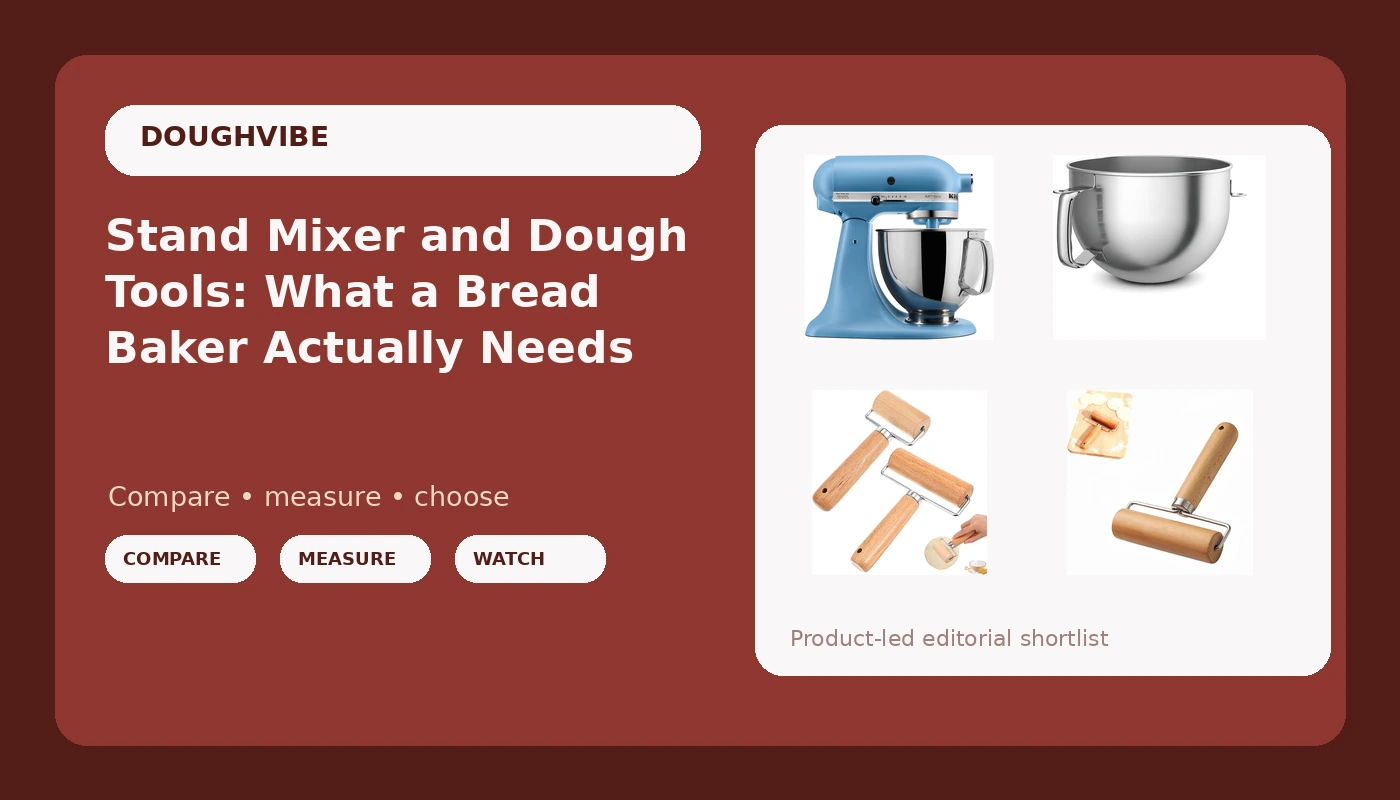
Most home bakers do not need a bigger kitchen. They need a clearer picture of which tools actually earn their counter space. The stand mixer and dough tools you keep within arm's reach decide how often you bake, how stiff a dough you are willing to attempt, and whether a Saturday loaf feels like a project or a chore. Get the kit wrong and the mixer becomes a monument. Get it right and it becomes the thing you reach for on a Tuesday.
This is an explainer, not a ranking. The four items below do genuinely different jobs at very different price points, and the goal is to help you figure out which of those jobs you actually have. One is a full stand mixer. One is a replacement bowl built for a specific family of bowl-lift machines. Two are wooden rolling pins that handle the shaping work a mixer never touches, no matter how much you paid for it.
Related: How to Choose a Stand Mixer for Bread Dough →
Quick answer
The KitchenAid Artisan 5-Qt Tilt Head Stand Mixer is the logical center of a home dough kit if you want one machine that mixes, whips, and kneads in a 5-quart tilt-head format. The 6 Quart Stainless Steel Mixer Bowl is worth adding only if you already own a KitchenAid bowl-lift mixer in the KP26 or KL26 family and want a second bowl for back-to-back batches. The two rolling pins cover shaping, and they differ mainly in handle style and how much drawer space they take up. None of the four is a commercial machine, and none is presented as one.
Four useful options
| Model | Best fit | What stands out |
|---|---|---|
| KitchenAid Artisan, 5-Qt Tilt Head Stand Mixer, KSM150PS, Blue Velvet | The main mixing and kneading machine | 5-quart tilt-head design, Artisan line, model KSM150PS, Blue Velvet finish |
| 6 Quart Stainless Steel Mixer Bowl for Kitchenaid Bowl-Lift Mixer KP26 KL26 | A spare bowl for an existing bowl-lift mixer | 6-quart stainless steel bowl listed as compatible with KP26 and KL26 bowl-lift models |
| 2 Pcs Baking Wooden Rolling Pins T-shape Pizza Dough Roller Pin Non-Stick Baker Pastry Roller Set | Shaping small rounds, pastries, and wrappers | Two T-handle wooden pins sold together as a set |
| Wooden Rolling Pin Set, Non-Stick Pizza & Dough Roller, Ergonomic Bakery Tool | Everyday rolling with compact storage | Single wooden pin described as non-stick with an ergonomic design |
The mixer: KitchenAid Artisan, 5-Qt Tilt Head Stand Mixer, KSM150PS, Blue Velvet
The tilt-head design is the trade-off to understand before you buy. The head tilts back to give you access to the bowl, which is convenient for scraping, adding flour, and swapping attachments. The alternative, a bowl-lift design, raises the bowl into a fixed head and generally feels steadier when a stiff dough starts climbing the hook. Tilt-head machines are perfectly capable of bread, but they ask more of the motor and more of the hinge, and a very heavy dough will make that difference audible. If your baking is mostly cakes, cookies, buttercream, and the occasional enriched loaf, the tilt head is the friendlier machine. If you plan to make two-pound lean doughs every week for a decade, read the bowl-lift section below and think carefully.
The spare bowl: 6 Quart Stainless Steel Mixer Bowl for Kitchenaid Bowl-Lift Mixer KP26 KL26
Bowl compatibility is the whole story here, and it is where most accessory purchases go wrong. This bowl is listed for the KP26 and KL26 bowl-lift models, not for tilt-head mixers, and a bowl that does not seat correctly on its arms is worse than no bowl at all. Before ordering, check the model number on the plate underneath your mixer rather than trusting your memory of what you bought. Note also that a larger bowl does not automatically mean a larger batch of bread dough. The bowl is one part of the system, and the motor is another. A six-quart bowl on a machine with a modest motor gets you more room to whip cream, not necessarily a bigger loaf.
The shaping set: 2 Pcs Baking Wooden Rolling Pins T-shape Pizza Dough Roller Pin Non-Stick Baker Pastry Roller Set
T-handle pins and straight French-style pins do different things, and it helps to know which one you are buying. A T-handle pin is held with both hands on the grips and pushed away from you, which gives good leverage on stiff dough and works well for tortillas, dumpling wrappers, and small pastry rounds. A straight tapered pin, the kind without handles, is rolled with flat palms and is the better tool for laminated dough and pie crust, where you want even pressure across a wide sheet without your hands introducing ridges. If you already own one style, the other is not redundant. Two pins in one set is a reasonable way to find out which one your hands prefer.
The everyday pin: Wooden Rolling Pin Set, Non-Stick Pizza & Dough Roller, Ergonomic Bakery Tool
Treat "non-stick" as a description of the surface finish, not a promise that dough will never stick. Wood is porous and it grips slightly, which is actually useful, because a pin with a little tooth picks up a dusting of flour and releases dough instead of sliding across a wet surface. The practical routine for any wooden pin is the same: dust lightly, never soak it in water, and wipe it clean rather than submerging it, because repeated soaking is what cracks wood and raises grain. Storage size is worth weighing honestly. If your drawers are shallow, a compact pin gets used far more often than a beautiful long one that lives in a cupboard.
Prices and availability may change. Product images, names, and retailer links must be matched by verified ASIN. Do not state a current price, rating, stock status, or measured result without current evidence.
Why motor torque matters more than wattage
Wattage tells you how much electricity a motor draws. Torque tells you whether it can turn a stiff dough hook without stalling. Those are related numbers, but they are not the same number, which is why two mixers with similar wattage ratings can behave completely differently the first time you load them with a two-pound lean dough.
Stiff dough is the hardest thing you will ever ask a mixer to do. It resists the hook, the resistance climbs as gluten develops, and the motor has to keep turning anyway. A machine that is comfortable whipping cream at high speed may be working much harder at low speed with a heavy load, and the symptoms of a motor at its limit are consistent: the head or bowl shudders, the speed drops under load, the housing gets warm, and eventually you smell hot windings. That smell is not a personality quirk. It is the motor telling you it was sized for a different job.
The practical takeaway is that you should judge a mixer by what happens in the first ten minutes of a stiff dough, not by the number on the box or the size of the bowl. If a machine slows audibly and heats up on your normal weekly bread, it is underpowered for your normal weekly bread, no matter what the marketing says. If you only ever mix cake batter and cookie dough, this entire section matters much less to you, and the tilt-head Artisan is a perfectly sensible machine for that life.
What a quart rating really tells you about dough
Bowl capacity is the most quoted and least useful number in mixer shopping. A five-quart bowl describes volume, and volume is what you measure when you fill a bowl with water. Dough is not water. It climbs, it wraps the hook, and it pushes against the sides, which means the real ceiling on a batch is set by the motor, the bowl geometry, and the hook design together.
Headroom is the concept worth internalizing. If a dough fills a bowl to the brim before it has finished kneading, you have no room for the hook to work and no room for the dough to expand, and you will spend the whole mix pushing it back down with a spatula. Most bakers are better served by a batch that fills a bowl roughly half to two-thirds full than by a batch that maxes it out. That is also why a bigger bowl is not automatically an upgrade: it gives you more room to work only if the machine underneath can actually turn the load.
A simple five-step way to decide what you need:
- Write down the largest dough you actually make in a normal month, in pounds, not in cups.
- Check whether your current machine stalls, slows, or heats up on that dough, since that is the real signal.
- Decide whether you are buying a mixer, a second bowl, or a shaping tool, because those are three different purchases.
- Confirm model numbers and compatibility before ordering any bowl or attachment, especially on bowl-lift machines.
- Match the tool to the dough: tilt head for cakes and occasional bread, bowl-lift for heavy weekly dough, pins for everything the mixer never touches.
Practical guidance for building the kit
- Buy the mixer for the dough you make most often, not the dough you make once a year at the holidays.
- If you already own a bowl-lift machine, verify the KP26 or KL26 model designation before ordering a replacement bowl.
- Keep a spare bowl only if you regularly run two batches in one session; otherwise it is cabinet space.
- Own one T-handle pin and one straight pin if you bake both pastry and bread, because they are not interchangeable in the hand.
- Never submerge a wooden rolling pin, and never judge one by a non-stick label alone; dust it with flour and see how it behaves.
Which option should you choose?
Choose the KitchenAid Artisan, 5-Qt Tilt Head Stand Mixer, KSM150PS, Blue Velvet when you want a single machine for mixing, whipping, and moderate kneading, and you value the tilt-head format and the KitchenAid attachment ecosystem. Choose the 6 Quart Stainless Steel Mixer Bowl for Kitchenaid Bowl-Lift Mixer KP26 KL26 when you already own a compatible bowl-lift mixer and want a second bowl so one dough can proof while the next one mixes. Choose the 2 Pcs Baking Wooden Rolling Pins T-shape Pizza Dough Roller Pin Non-Stick Baker Pastry Roller Set when your baking leans toward tortillas, dumplings, and small pastry rounds where a T-handle gives you leverage. Choose the Wooden Rolling Pin Set, Non-Stick Pizza & Dough Roller, Ergonomic Bakery Tool when you want one compact pin in the drawer for cookies, pie, and pizza dough.
One caution applies to all four items: the details above come from the product listings, not from a bench test, and listing language such as "non-stick," "heavy duty," and "ergonomic" describes how a manufacturer positions a product rather than a measured result. Compatibility claims in particular should be checked against your own mixer's model plate before you buy.
The bottom line
A dough kit is not one purchase. It is a machine, the bowl situation around that machine, and the shaping tools that finish what the mixer starts. If you are starting from nothing, the KitchenAid Artisan is the sensible center of that kit for most home bakers. If you already own a bowl-lift mixer, a compatible spare bowl is a smaller and more targeted upgrade. And whatever you mix, a wooden rolling pin is the cheapest tool in the drawer that you will use more often than you expect. Start with the dough you actually make, and let the equipment follow.