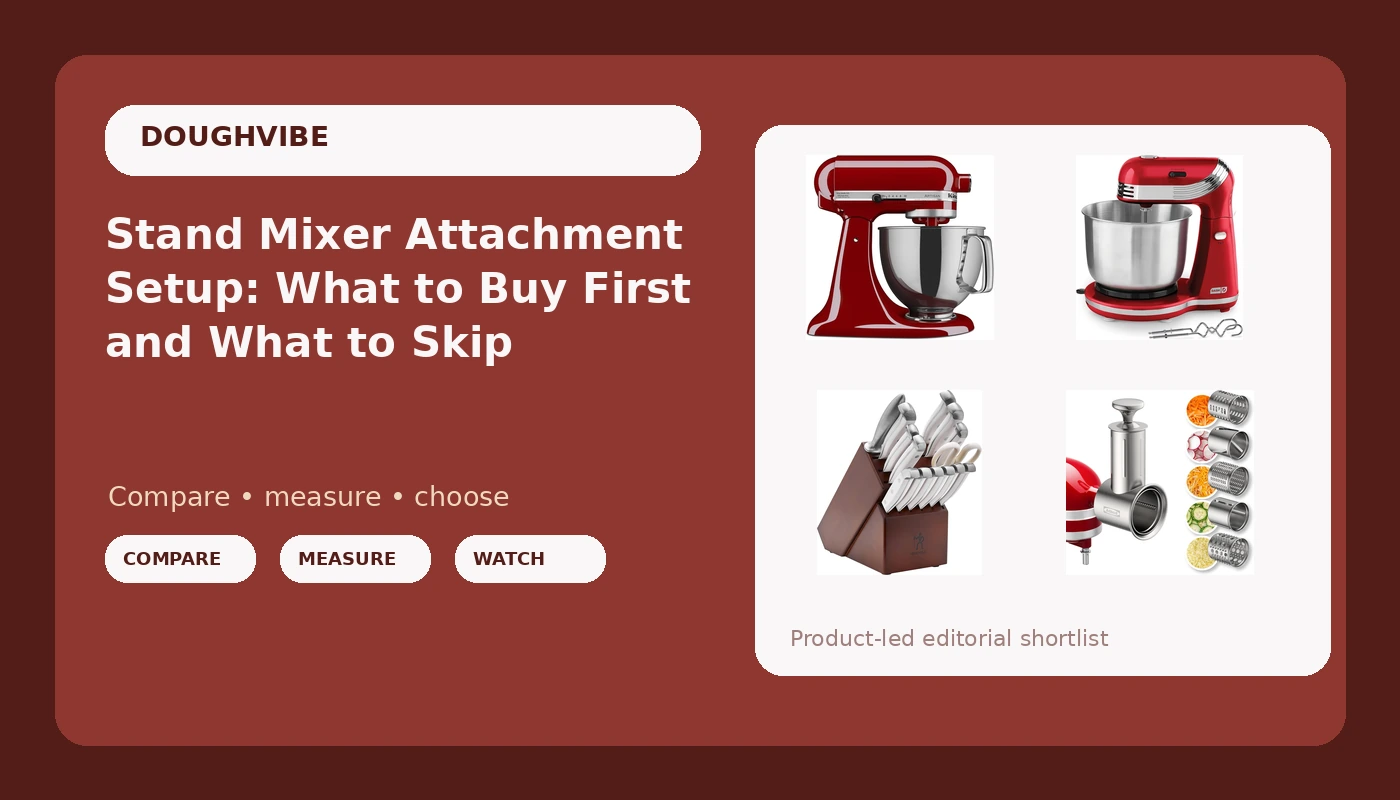
Most people shopping for a stand mixer are really shopping for two things at once: the machine that lives on the counter and the set of jobs it can take over. That second part, the stand mixer attachment setup, is where the rest of the money goes, and it is where most buyers get surprised. The mixer you choose decides which attachments will ever fit it. The bowl decides how much dough you can make in one go. The counter space you have decides whether a compact model is a compromise or the smart call. This guide works through four pieces of equipment that cover the common home baking jobs: a full-size tilt-head mixer, a compact mixer for small batches, a slicer shredder add-on, and the knife set that handles everything before the dough even starts.
Related: Stand Mixer Buying Checklist for Home Bakers →
Quick answer
A stand mixer earns its counter space when its motor and bowl match the dough you make most often, and attachments earn their place only when they replace a job you already do by hand. For a kitchen that bakes bread, cookies, and cakes regularly, a full-size tilt-head mixer with a broad attachment ecosystem covers the most ground. For small batches and tight counters, a compact 3-quart model does similar work in less space. A slicer shredder attachment is often the add-on that pays off first because it takes over from a box grater. A 15-piece knife set supports everything upstream of mixing. Always confirm that an attachment is built to fit your specific mixer before you buy it.
Four useful options
| Model | Best fit | What stands out |
|---|---|---|
| KitchenAid Artisan, 5-Qt Tilt Head Stand Mixer, KSM150PS, Empire Red | Regular baking across cakes, cookies, and bread | 5-quart tilt-head design that many third-party attachments are built to fit |
| Stainless Steel Slicer Shredder Attachment for KitchenAid Stand Mixer, Cheese Grater Attachment for KitchenAid with 5 Blades, Dishwasher Safe | Replacing hand grating and slicing | Five interchangeable blades and dishwasher-safe parts |
| Dash Everyday Stand Mixer - Compact Tilt-Head Stand Mixer for Everyday Recipes - 6-Speed Power with Stainless Steel Bowl - Red, 3-Quart | Small kitchens and small batches | Compact 3-quart tilt-head with a 6-speed control and stainless steel bowl |
| Henckels Statement 15-Pc Knife Set, Razor-Sharp, German Engineered, White | Prep work before anything hits the bowl | 15-piece set described as German engineered with a white handle design |
The all-rounder: KitchenAid Artisan, 5-Qt Tilt Head Stand Mixer, KSM150PS, Empire Red
The case for starting here is ecosystem, not badge appeal. A front hub that accepts powered attachments turns one motor into a grater, a slicer, a spiralizer, or a pasta roller, and that is the difference between a mixer and a kitchen system. The trade-off is the tilt head itself. Tilting gives you fast, easy access to the bowl and the beater, which matters when you are scraping down a cake batter four times. Under very stiff dough, though, the head is the part that moves, and bakers who make heavy bread every week often prefer a lift-bowl design where the bowl rises on arms instead. Neither design is wrong. It depends on whether your weekly routine is closer to buttercream or to a two-pound loaf. If you bake bread constantly, plan on the mixer working for its living and give it rest between loaves.
The add-on: Stainless Steel Slicer Shredder Attachment for KitchenAid Stand Mixer, Cheese Grater Attachment for KitchenAid with 5 Blades, Dishwasher Safe
This is the add-on that justifies the mixer's front hub for a lot of cooks. Shredding a block of cheese by hand is one of those jobs nobody enjoys, and a powered version runs at mixer speed while you keep your hands free. The compatibility point matters more than anything else here: this attachment is built for KitchenAid stand mixers, so if your mixer is a different brand or a different mount style, it will not fit. Buy the mixer first, then buy attachments that are confirmed to match it. Cleanup is the other thing to weigh honestly. Five blades means five parts, and while the parts are dishwasher safe, you still have to disassemble and rinse before anything goes in the rack. That is a fair trade for skipping the box grater, but only if you actually grate in volume.
The compact pick: Dash Everyday Stand Mixer - Compact Tilt-Head Stand Mixer for Everyday Recipes - 6-Speed Power with Stainless Steel Bowl - Red, 3-Quart
A 3-quart bowl is a real constraint, and it is worth naming plainly. It handles a single cake, a batch of cookie dough, whipped cream, and frosting without drama. It will not handle a double batch of bread dough, and no compact mixer in this class will. The upside is that a small bowl and a light body mean the mixer comes out of the cabinet more often, which is the only metric that matters in a small kitchen. If you bake a dozen cookies twice a month, this covers it. If you bake four loaves on Sunday, you want the larger bowl and the heavier motor, and you want to accept that the machine is going to be heavy on the counter. Choose the size that matches your normal week, not your holiday week.
The prep side: Henckels Statement 15-Pc Knife Set, Razor-Sharp, German Engineered, White
Knives look out of place in a mixer article until you watch someone make an apple galette. Every mix-in, every chopped nut, every zested citrus, and every trimmed pastry edge happens before the mixer does anything. A dull knife slows down the half of the recipe the mixer cannot help with. Fifteen pieces is more than most home cooks need, and that is worth saying. What matters is that the set covers a chef's knife, a paring knife, and a serrated blade, and that the handles feel secure when your hands are buttery. Buy the set for the core knives and treat the extras as a bonus, not a reason.
Prices and availability may change. Product images and names are matched to the retailer listing, and specifications can be updated by the maker over time. Confirm current details, ratings, and stock on the retailer page before you buy.
What actually decides whether a mixer can handle your dough
Bowl size and motor power are two different numbers, and marketing tends to blur them. A 5-quart bowl describes volume, not the weight of stiff dough the machine can push through a hook without stalling. The relevant figure is torque, the twisting force at the shaft, and it is rarely printed on the box. Wattage tells you how much power the motor draws, which is a hint, not a guarantee. A mixer can draw plenty of watts and still bog down when dough gets stiff, because gearing and head stability matter just as much.
This is why the practical test for any mixer is bread, not cake. Cake batter is soft and forgiving. A stiff dough fights back, and it exposes the whole design: whether the head flexes, whether the bowl walks across the counter, whether the hook climbs the dough or buries itself in the center. The honest check after a long knead is simple. If the motor housing smells hot after ten minutes of dough, that mixer is working at or past its limit for that job. It is not broken. It is just not sized for what you asked it to do.
Tilt head versus lift bowl follows from the same logic. Tilt heads win on access and counter clearance. Lift-bowl designs win on stability under load, because the bowl rides on arms and the head stays put. For a weekly bread baker, the lift bowl is usually the better long-term structure. For a baker who mostly creams butter and folds batter, the tilt head is easier every single day.
Where attachments fit, and how to choose them
Attachments are the reason a mixer purchase is really a platform decision. Most powered attachments drive off a hub at the front of the machine, which means they depend entirely on the mount your mixer has. That is the single most common buying mistake: someone buys a grater attachment for a mixer it was never built to fit. Check the compatibility line on the attachment listing against your exact mixer model before you order.
The second rule is frequency. An attachment is worth owning when it replaces a task you do at least monthly. A slicer shredder earns its spot in a kitchen that goes through blocks of cheese and bags of carrots. A pasta roller earns its spot only if you actually make pasta. Storage and cleanup decide the rest, because an attachment that is annoying to wash gets used twice and then lives in a drawer.
- List the three things you bake or cook most often in a month, not the ones you daydream about.
- Match the bowl size to your largest regular batch, not your largest holiday batch.
- Decide tilt head or lift bowl based on how much stiff dough you actually make.
- Confirm attachment compatibility with your exact mixer model before buying any add-on.
- Budget for the setup, not just the machine, since attachments are where the real spending continues.
Practical notes before you buy
- Measure your counter and your cabinet clearance before choosing a full-size mixer over a compact one.
- Weigh your flour for bread instead of scooping, because a heavy scoop can push a mixer past what the dough was supposed to be.
- Give any mixer a rest between consecutive loaves rather than running three in a row back to back.
- Buy attachments one at a time and use each one for a month before adding the next.
- Keep knives sharpened and stored dry, since a set that lives in a damp drawer loses its edge fast.
Which option should you choose?
Choose the KitchenAid Artisan, 5-Qt Tilt Head Stand Mixer, KSM150PS, Empire Red when you bake regularly across cakes, cookies, and bread and you want the machine that the widest range of attachments is built to fit. Choose the Stainless Steel Slicer Shredder Attachment for KitchenAid Stand Mixer, Cheese Grater Attachment for KitchenAid with 5 Blades, Dishwasher Safe when you already own a compatible KitchenAid mixer and you grate or slice often enough that a box grater has become a chore. Choose the Dash Everyday Stand Mixer - Compact Tilt-Head Stand Mixer for Everyday Recipes - 6-Speed Power with Stainless Steel Bowl - Red, 3-Quart when your batches are small, your counter is short, and a full-size mixer would sit in a closet. Choose the Henckels Statement 15-Pc Knife Set, Razor-Sharp, German Engineered, White when the prep side of your cooking is the bottleneck and you want one purchase to cover chopping, trimming, and slicing.
One caveat applies to all four. The features listed here come from the product records, not from a measured test, so treat capacity and blade counts as starting points for your own comparison. Fit, feel, and how a machine behaves under your specific dough are things only your kitchen can answer.
The bottom line
A stand mixer attachment setup is a sequence, not a single purchase. Start with the mixer whose bowl and motor match the baking you do most weeks, confirm that the attachments you want are built to fit it, and add the slicer shredder when grating by hand has worn you down. If your batches are small, the compact 3-quart model keeps the whole operation on the counter instead of in a cabinet, and a solid knife set handles the prep work that no mixer can touch. Buy for the routine you actually keep, and the equipment will earn its space.