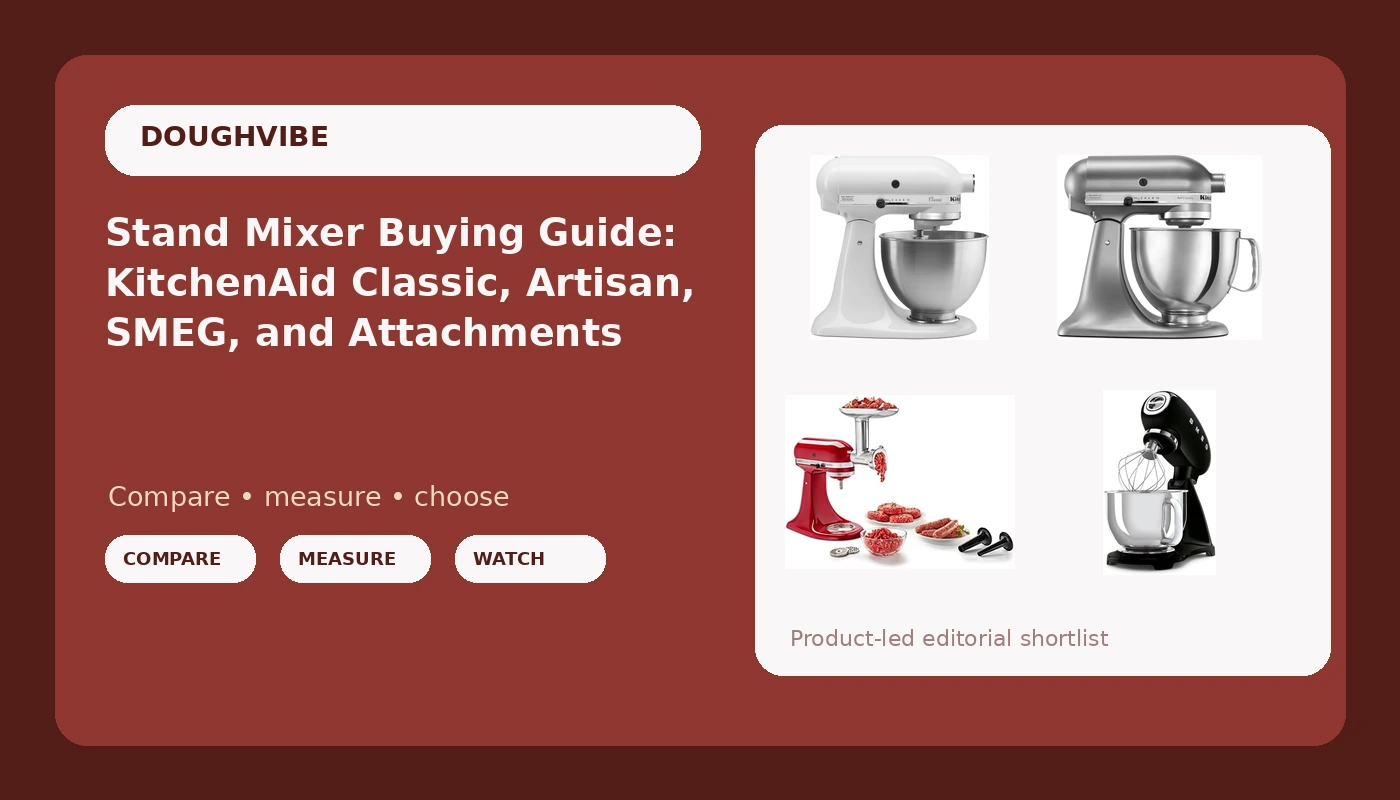
Most people who open a stand mixer buying guide already know the shape of the answer they want: one machine on the counter that whips cream, creams butter, kneads bread, and maybe grinds a batch of pork on a Sunday. The four products in this comparison are not four versions of that same decision. Two are KitchenAid tilt-head mixers that differ mainly in bowl size and series, one is a five-quart SMEG with ten speeds and a stainless steel bowl, and one is not a mixer at all. It is a grinder attachment that turns a KitchenAid mixer into something more. Choosing well starts with knowing which job you are actually buying for.
Related: Bowl Size vs Batch Size: What Your Mixer Can Really Knead →
Quick answer
If you want a compact tilt-head mixer with a 4.5-quart bowl, the KitchenAid Classic Series K45SS is the smaller, simpler option in this group. If you want a 5-quart bowl and the Artisan series name, the KitchenAid Artisan KSM150PS is the step up. If you want ten speeds, a stainless steel bowl, and a retro-styled body, the SMEG SMF03 is the one to look at. And if you already own a KitchenAid stand mixer and want to grind meat or make sausage, the KitchenAid KSMMGA food grinder attachment is an add-on rather than a new machine. None of these is automatically the right answer for every kitchen, because bowl volume and attachment compatibility decide more than the badge on the front.
Four useful options
| Model | Best fit | What stands out |
|---|---|---|
| KitchenAid Classic Series 4.5 Quart Tilt-Head Stand Mixer K45SS, White | Smaller kitchens and lighter mixing routines | 4.5-quart bowl, the smallest capacity here, in a tilt-head design |
| KitchenAid Artisan, 5-Qt Tilt Head Stand Mixer, KSM150PS, Contour Silver | Bakers who want a 5-quart bowl and the Artisan line | 5-quart bowl in a tilt-head body, Contour Silver finish |
| KitchenAid KSMMGA Food Grinder Attachment for All KitchenAid Stand Mixers | KitchenAid owners who want grinding capability | A food grinder attachment listed for all KitchenAid stand mixers |
| SMEG SMF03 Stand Mixer, 5 Qt Tilt-Head with Stainless Steel Bowl, 10 Speeds, Retro 50s Vintage Style, Black | Buyers who want ten speeds and a retro look | 5-quart capacity, stainless steel bowl, ten speeds, black retro body |
The entry point: KitchenAid Classic Series 4.5 Quart Tilt-Head Stand Mixer K45SS, White
The honest trade-off with a 4.5-quart bowl is headroom, or the lack of it. Bowl capacity is a volume figure, not a dough weight, and the gap between what a bowl can hold and what a motor can push through stiff dough is where most disappointment lives. A smaller bowl fills faster, which means a double batch of bread dough runs out of room before it runs out of anything else. On the other side, a smaller bowl and a lighter body are easier to live with on a crowded counter and easier to move when you need the space back. If your typical week is cookies, cake batter, whipped cream, and one loaf at a time, the Classic Series capacity is not a compromise at all. If you already know you want to feed a crowd, this is the option you will outgrow first.
The step up: KitchenAid Artisan, 5-Qt Tilt Head Stand Mixer, KSM150PS, Contour Silver
Half a quart sounds trivial until you are scraping the last of a batch off the rim of a full bowl. The Artisan is the middle of this group in practical terms: more room than the Classic Series, the same tilt-head layout, and a finish that reads as a deliberate choice rather than a default. The tilt-head design is worth understanding before you buy into it. The head lifts back so you can get a spatula under the beater, which is convenient for cakes and icings, and it means the bowl sits in a cradle rather than locking into arms. For heavy, stiff dough, that cradle is the part that decides whether the machine feels planted or busy. If bread is a weekly event rather than an occasional project, read the section on tilt-head behavior below before you commit.
The add-on: KitchenAid KSMMGA Food Grinder Attachment for All KitchenAid Stand Mixers
This is the product that quietly reframes the whole comparison. If you already own a KitchenAid stand mixer, the cheapest way to add a genuinely new capability is often an attachment, not a second appliance. Grinding your own meat is the classic example, and it is the kind of job that a mixer hub handles well because the motor is already turning a shaft at the front of the head. The catch is that attachments are a system commitment. They take up drawer space, they need cleaning, and they only make sense if you will actually use them more than twice a year. The other catch is compatibility: this attachment is specified for KitchenAid stand mixers, so it pairs with the Classic Series and the Artisan here, and it is not the accessory path for the SMEG. If your real goal is a grinder, buy the attachment. If your real goal is a bigger bowl, an attachment will not solve that.
The style-forward option: SMEG SMF03 Stand Mixer, 5 Qt Tilt-Head with Stainless Steel Bowl, 10 Speeds, Retro 50s Vintage Style, Black
Ten speeds on a dial is more than most mixing tasks need, but the extra steps are useful in the slow range, where a gentle fold or a gradual start on a stiff dough matters more than top-end speed. A stainless steel bowl is a practical detail too: it is durable, it does not hold onto odors the way some materials can, and it chills well if you are working with pastry. The real question with a SMEG is the same one you should ask of any mixer that is not part of the KitchenAid ecosystem, and that is accessory support. The KSMMGA grinder in this comparison is specified for KitchenAid stand mixers, so a SMEG purchase is a commitment to SMEG's own accessory line rather than the wider aftermarket. If the retro body is what makes you want to bake more often, that is a legitimate reason to buy it. Just go in knowing the attachment path looks different.
Prices and availability may change. Product images, names, and retailer links must be matched by verified ASIN. Do not state a current price, rating, stock status, or measured result without current evidence.
How tilt-head mixers handle stiff dough
Three of the four products here are tilt-head designs, so it is worth being precise about what that means. On a tilt-head mixer, the head hinges back on a joint at the rear, the bowl sits in a cradle on the base, and the head locks down into position for mixing. On a lift-bowl mixer, the head stays fixed and the bowl rises on arms to meet it. Both designs work. They fail in different ways under load.
The practical difference shows up with stiff dough, the kind that fights back: bagel dough, a low-hydration sourdough, a heavy brioche. Stiff dough does not just need speed, it needs torque, which is the twisting force that keeps the hook turning when the dough resists. A machine can whip cream effortlessly and still labor on a stiff dough, because whipping and kneading are different jobs with different demands. On a tilt-head design, the bowl cradle is the part that takes the strain, and a loose or poorly seated bowl will move under a heavy load. That movement is what people mean when they say a tilt-head wobbles. It is not a defect in the design so much as a reminder to lock everything down and to respect the batch size the machine was built around.
There is also a sensory check that costs nothing. If the motor or the head starts to smell hot after ten minutes of kneading, the machine is being asked to do more than it was designed for, and no bowl size in the world fixes that. Bowl capacity numbers describe volume, not dough weight, and the two are not the same figure. A five-quart bowl can physically hold more dough than the machine behind it can comfortably push. That gap is where most mixer disappointment comes from, and it is the reason to think about your heaviest regular batch before your lightest one.
A five-step way to narrow the choice
Work through these in order and the decision usually makes itself.
- Write down the stiffest dough you actually make in a normal month, not the one you imagine making.
- Compare that batch against bowl capacity, remembering that volume and dough weight are different numbers.
- Decide whether you want a tilt-head layout for easy bowl access or a lift-bowl layout for a more planted bowl under load.
- Check which attachments you would genuinely use, and confirm they are made for the mixer brand you are considering.
- Budget for the attachments you want at the same time as the mixer, because the accessory line is where the long-term cost lives.
What to check before you buy
- Measure your counter and your overhead clearance. A tilt-head mixer needs room to hinge back, and a tall machine under a low cabinet is a daily annoyance.
- Confirm the bowl size against your largest regular batch rather than your average one.
- Verify attachment compatibility for the specific model, not the brand in general. The KSMMGA grinder is listed for all KitchenAid stand mixers, which covers both KitchenAid options here.
- Think about weight and where the machine will live. A mixer you have to lift out of a cupboard is a mixer you will use less.
- Read the warranty and service terms for your region before you order, since coverage and repair options vary.
- Treat bundles with suspicion. Pay for the attachments you will use, not the ones that make the listing look generous.
Which option should you choose?
Choose the KitchenAid Classic Series 4.5 Quart Tilt-Head Stand Mixer K45SS, White when you mix in smaller batches and want a compact tilt-head machine with a 4.5-quart bowl. Choose the KitchenAid Artisan, 5-Qt Tilt Head Stand Mixer, KSM150PS, Contour Silver when you want a 5-quart bowl and the Artisan line in a tilt-head design. Choose the KitchenAid KSMMGA Food Grinder Attachment for All KitchenAid Stand Mixers when you already own a KitchenAid stand mixer and want to add grinding rather than replace the machine. Choose the SMEG SMF03 Stand Mixer, 5 Qt Tilt-Head with Stainless Steel Bowl, 10 Speeds, Retro 50s Vintage Style, Black when ten speeds, a stainless steel bowl, and a retro body are the details that matter most to you.
One caveat applies to all four: this comparison is built from the supplied product records, not from a bench test, so treat the design descriptions as a starting point. Verify current specifications, included accessories, and warranty terms on the listing before you buy, and do not assume that bowl capacity alone tells you what a machine can knead.
The bottom line
The KitchenAid Classic Series and the KitchenAid Artisan are the same idea at two bowl sizes, and the half quart between them is the main decision if you are choosing between those two. The SMEG SMF03 sits in the same 5-quart territory with a different speed range, a stainless steel bowl, and a distinctly retro look, plus a different accessory ecosystem to plan around. The KSMMGA grinder is the odd one out and often the most useful purchase for someone who already has a KitchenAid mixer on the counter, because it adds a capability instead of duplicating one. Pick the machine that matches your heaviest regular batch, then decide whether the attachment you want is part of the same brand family. That order of thinking will serve you longer than any single specification.