Walk into any store that sells stand mixers and every box shouts the same number: quart capacity. Three quarts, three and a half, five. What the labels leave out is that stand mixer sizes describe a bowl, not a job, and the job is what decides whether you still like the machine in year three. A big bowl on a small motor is the worst combination in the category, because it invites you to fill it with dough the motor cannot turn. A smaller bowl driven by real torque will outwork it on bread every single time.
This is an explainer, not a scoreboard. Below are four products, three of them mixers and one of them not, with the honest limits of each size spelled out so you can stop shopping by quart count and start shopping by the dough you actually make.
Related: How to Knead Bread Dough in a Stand Mixer Without Stalling the Motor →
Quick answer
Bowl capacity is a dough limit, not a serving count. A 3-quart machine is a small-batch mixer for cookies, frosting, and single small loaves. A 3.5-quart model buys a little more headroom in nearly the same footprint. A 5-quart machine with an 800-watt motor is the size where stiff bread dough stops being a gamble. Match the bowl to the largest batch you truly make, then check the motor, because capacity without power is the trap in this category. If your baking is mostly cakes and quick breads, a compact mixer is enough. If you bake bread weekly, buy the motor first and the bowl second.
Four useful options
| Model | Best fit | What stands out |
|---|---|---|
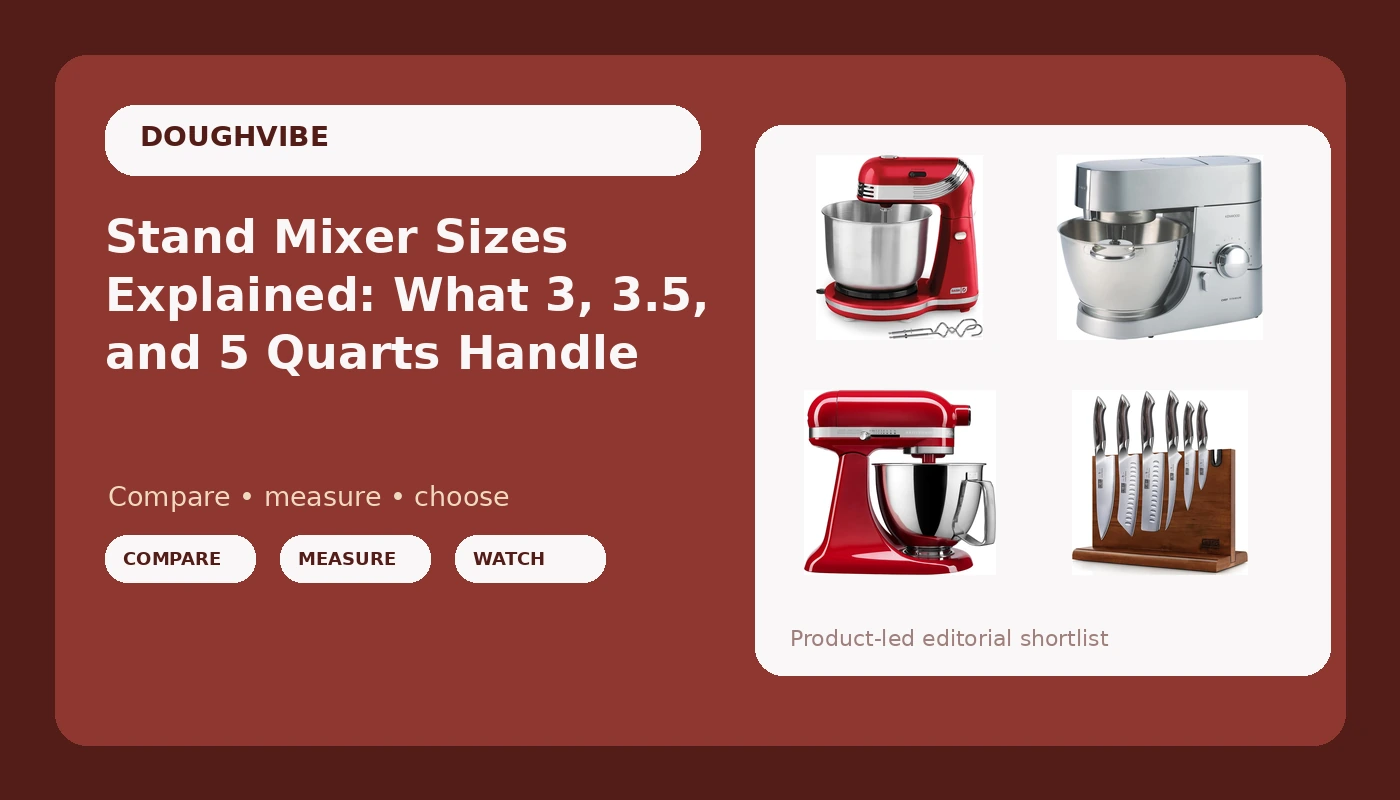
| Dash Everyday Stand Mixer | Small-batch cookies, frosting, and single-layer cakes | 6-speed tilt-head with a 3-quart stainless steel bowl |
| KitchenAid Artisan Mini | Small kitchens that want a little more bowl than a 3-quart compact | 3.5-quart tilt-head capacity in the Artisan line |
| Kenwood Chef Titanium Kitchen Machine | Bread dough and larger batches in a mid-size footprint | 800W motor, electronic variable speed control, and three mixing tools included |
| HOSHANHO 7-Piece Knife Set | Cutting and prep work around a baking setup | Seven pieces stored on a Japanese magnetic knife block |
The compact starter: Dash Everyday Stand Mixer
A 3-quart bowl makes batch size the limit rather than power. Creaming butter for one cake, whipping a pint of cream, mixing a single batch of muffin batter: all comfortable work. Two pounds of stiff sourdough is not this machine's job, and no speed setting changes that. Buy it when your baking is cakes, cookies, and quick breads, and accept the bowl as the ceiling you are choosing on purpose.
The small-batch upgrade: KitchenAid Artisan Mini
Half a quart sounds like marketing noise until you are scraping down a bowl that is nearly full. Extra headroom gives dough somewhere to go while it is being mixed, and that matters more than the raw number suggests. It is still a small-batch machine. If you want two sandwich loaves at once, this is not the size. If you want one small loaf plus a batch of cookies in the same session, it is.
The motor-first pick: Kenwood Chef Titanium Kitchen Machine
The motor figure and the bowl size have to be weighed together. Power without capacity means you knead a small batch very confidently. Capacity without power means you fill a bowl the motor cannot turn. Together they put this machine in the range where a weekly bread bake is realistic rather than aspirational. The dishwasher-safe bowl and the included mixing tools also mean you are not buying the basic kit separately on day one, which is how a mixer purchase quietly doubles in cost.
The prep-side companion: HOSHANHO 7-Piece Knife Set
Every stand mixer roundup has one item that does not belong and still does. This is that item. Nothing about a knife set changes how dough develops, and no knife kneads. But a baking kitchen runs on both sides of the counter, and when people outfit from scratch, the cutting side is usually where they under-buy. Treat it as a separate decision from your mixer rather than a bundled upgrade.
Prices and availability may change. Product images, names, and retailer links must be matched by verified ASIN. Do not state a current price, rating, stock status, or measured result without current evidence.
Bowl capacity versus dough capacity
A quart rating tells you the volume of the bowl. It does not tell you how much dough that bowl can turn. Those are different numbers, and the gap between them is where most disappointing mixer purchases happen. Dough is heavy, it climbs the hook, and it resists being moved. A stiff, low-hydration dough loads a motor far harder than a wet, slack one of the same weight. So a machine that whips cream effortlessly can still slow to a crawl on bagel dough.
Wattage is a power draw figure, not a promise. Torque is the twisting force that actually moves a hook through stiff dough, and the two do not scale together the way shoppers assume. That is why the honest test for any mixer is not the cream test or the cake mix test. It is whether the machine keeps turning when the dough gets stiff and whether it still sounds normal afterward.
Design matters too. A tilt-head mixer swings the head back on a hinge, which is convenient for scraping and adding ingredients, and the head has to stay stable under load. A lift-bowl design raises the bowl into a fixed head, which is the sturdier arrangement for heavy dough. Neither is wrong, but if bread is your priority, that structural difference is worth thinking about before the quart number.
One more thing the box will not tell you: attachments often cost more than the mixer. A machine with a real attachment ecosystem is a kitchen system. A machine with three proprietary add-ons that cost half the mixer price is a gadget. Decide which one you are buying.
How to match a mixer to the way you bake
- Write down your largest regular batch, not your dream batch. If you make one loaf and a dozen cookies most weeks, a 3-quart or 3.5-quart machine covers it. If you make two loaves at a time, you are shopping in the 5-quart range.
- Check the motor rating before the bowl size. An 800W figure is a concrete starting point. A mixer with no stated motor rating and a large bowl is a warning sign, not a bargain.
- Decide between tilt head and lift bowl based on dough, not storage. Tilt heads are easier to work around. Lift-bowl designs are more stable under stiff dough. If bread is the reason for the purchase, weigh that.
- Count the tools that come in the box. A work bowl plus three mixing tools means you can start baking the day it arrives. A bowl-only listing means a second purchase before your first loaf.
- Measure your counter before you fall in love with a machine. A mixer you have to haul out of a cupboard is a mixer you will stop using, and that is a worse outcome than buying one size smaller than you wanted.
Practical guidance before you buy
- Weigh your flour instead of scooping it. Dough hydration, and therefore how hard your mixer works, changes with every extra scoop of flour.
- Keep a stiff dough batch smaller than you think you should. Bowl volume is not a dough allowance, and overfilling is how motors get stressed.
- Plan attachment purchases as a separate budget line. Bundles look efficient until you are paying for tools you will never mount.
- Give the machine a rest between heavy batches. Back-to-back stiff dough is the hardest thing you can ask of any mixer in this class.
- If you are outfitting a kitchen from nothing, budget the cutting side separately. Knives and mixers solve different problems and should not compete for the same dollars.
Which option should you choose?
Choose the Dash Everyday Stand Mixer when your baking is cakes, cookies, frosting, and quick breads, and counter space or budget is the binding constraint. Choose the KitchenAid Artisan Mini when you want a little more bowl room than a 3-quart compact without giving up the small footprint. Choose the Kenwood Chef Titanium Kitchen Machine when bread is the point and you want a stated 800W motor with a 5-quart work bowl and the mixing tools included. Choose the HOSHANHO 7-Piece Knife Set when the cutting side of your kitchen is what is actually missing, and treat it as unrelated to your mixer decision.
Specifications here come from the product listings rather than from laboratory measurement, and dough behavior depends on hydration, flour, batch size, and how long you mix. A machine that handles one baker's weekly loaf comfortably may struggle with another's stiffer, larger batch. Buy for your own dough, and be honest about how big that batch really is.
The bottom line
Stand mixer sizes are a starting filter, not an answer. A 3-quart bowl sets a small-batch ceiling. A 3.5-quart bowl adds working room without adding much footprint. A 5-quart bowl with an 800W motor is the size where bread stops being a risk, and the motor rating is what makes that capacity usable. Pick the bowl that matches your largest regular batch, confirm the motor can turn it, and count the tools included so the real cost is visible before you buy. Then keep the knife set on a separate list, because it will never knead a thing.