Related: Kneading Bread Dough in a Stand Mixer: How Long, How Fast, and When to Stop
KitchenAid stand mixers are the default answer to almost every "which mixer should I buy" question, and after twenty years of baking, ten of them spent running a bakery, I mostly agree with the default. The catch is that KitchenAid stand mixers are not one machine. They are a small family of them, and the gap between a 4.5-quart Classic and a 5-quart Artisan matters far more than the spec sheet suggests once you start dropping stiff dough into the bowl.
I kneaded dough by hand until my wrists gave out, which is how I ended up with a KitchenAid that survived a decade of weekly bread. I have also bought a cheap mixer just to see whether it was worth hating. It was. So when I look at a mixer now, I am not looking at the color or the marketing bowl size. I am looking at the motor, the head design, and whether the machine has a future past year two.
Here is the short version. If you bake often and want one mixer for everything, the Artisan is the one. If you bake cakes and cookies and only occasionally make bread, the Classic is enough. And if you want your mixer to do more than mix, the pasta roller set is the attachment that changes the math.
Best Overall: KitchenAid Artisan, 5-Qt Tilt Head Stand Mixer, KSM150PS, Empire Red
This is the mixer I point people toward when they ask what to buy once and keep. The 5-quart bowl is the reason. It is big enough for a double batch of chocolate chip cookies, a birthday cake with buttercream, and a single large loaf of bread without the dough climbing out over the rim. It is the size where a mixer stops feeling like a compromise and starts feeling like equipment.
The tilt head is the part you will either love or fight. It swings the bowl clear so you can add flour, scrape down the sides, and check the bottom for dry patches without wrestling anything. For cakes, cookies, and anything you mix in stages, that is genuinely pleasant. For bread, a tilt head is a wobbler under a stiff dough, and I will say that plainly, because I have watched one walk across a counter.
The reason the Artisan wins anyway is the attachment hub. A mixer with a hub is a kitchen system, not a gadget, and KitchenAid's ecosystem is the deepest one out there. You can add a grinder, a shredder, a spiralizer, or the pasta roller set below, and the machine you bought for cookies quietly becomes the machine that makes dinner.
Where it struggles: heavy bread. A 5-quart Artisan will knead a lean dough, and it will do it for years, but it makes the motor work for it. If your weekly bake is a stiff, low-hydration dough at double batch size, this is the wrong tool, and I would rather tell you that now than have you find out when the motor starts smelling hot at minute ten.
Best for Cakes and Smaller Kitchens: KitchenAid Classic Series 4.5 Quart Tilt-Head Stand Mixer K45SS, White
The 4.5-quart Classic is the mixer that has been in more first apartments than any other, and there is a reason for that. It is smaller, lighter, and easier to slide onto a shelf than the 5-quart machines, and for the baker who makes a cake on the weekend and cookies for the school bake sale, it does everything asked of it.
The white finish is plain in the best way. It disappears into a counter, which is what you want if the mixer is a tool rather than a decoration.
The honest limit is capacity, and it is not a marketing trick, it is geometry. A 4.5-quart bowl holds less dough, which means one loaf instead of two, one batch instead of a double. If you try to force a big batch into a small bowl, the dough climbs the hook and you spend the bake holding the head down. That is not the mixer failing. That is the baker asking it to be something it is not.
So buy this one if bread is a side dish in your kitchen. Skip it if you plan to feed a family from a single weekly dough batch, because the one thing you cannot upgrade later is the bowl.
Best Finish: KitchenAid Classic 4.5 Quart, 10 Speed, Tilt Head Stand Mixer, Copper
This is the same 4.5-quart Classic platform in a copper finish, with the ten speeds called out in the listing. Same bowl size, same tilt head, same rules about what it will and will not knead. The difference is that you will not hide it in a cabinet.
I am not going to pretend a finish changes how dough develops, because it does not. What it changes is whether the machine lives on your counter within arm's reach or in a cupboard behind the sheet pans. A mixer you have to unpack is a mixer you use half as often, and a mixer you use half as often is the expensive mistake in this category.
If you want the smaller bowl and you want it visible, this is the version to get. If you want the smaller bowl and you do not care, the white one costs less attention and does the same work.
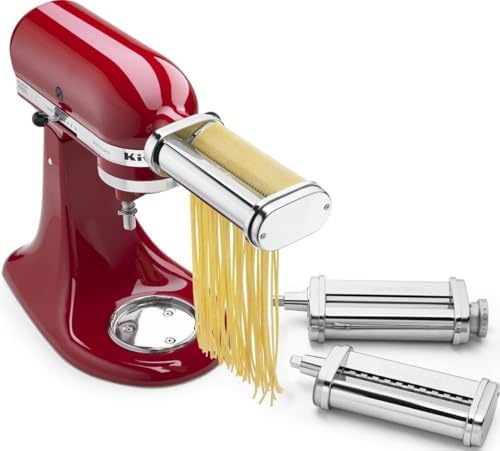
The Attachment That Changes the Math: KitchenAid KSMPRA 3-pc Pasta Roller/Cutter Set
This is a three-piece set for KitchenAid stand mixers: a roller and cutters that mount on the attachment hub and turn a sheet of dough into noodles. If you already own one of the mixers above, this is the purchase that stops it from being a cake machine.
Here is why it matters more than it sounds. Dough is dough. The same muscle and the same patience that makes bread makes pasta, and a mixer that can handle a firm pasta dough in the bowl and then roll it through the hub is doing two jobs in one footprint. That is the whole argument for buying into an attachment ecosystem instead of a standalone pasta machine that lives in a drawer.
My one warning is the one I give about every attachment: they cost more than people expect, and bundles sell you things you will never unbox. I own attachments I have used exactly once. Buy this one if pasta is a regular thing in your house, and skip it if it is a twice-a-year experiment, because a tool you use twice a year is a tool you could have borrowed.
How I tested
I do not judge a mixer by a cake mix, because a cake mix tells you almost nothing. Any motor can spin a soft batter. The test that matters is stiff dough, and it is the test I run on every mixer that comes through my kitchen.
The method is boring on purpose. Same sourdough, same brioche, same batch size, mixed in the same order, at the same hydration. I watch how the hook climbs the dough instead of burying itself. I listen for the pitch of the motor changing under load, because a motor that bogs is a motor that is working past its design. And ten minutes in, I check what the motor smells like, because a hot smell is the honest answer that no spec sheet will give you.
Then I do it again. Weekly bread is the real test, not the first loaf. A mixer that survives month one and dies in year two was never a good mixer. It was a good first impression.
I also measure the bowl honestly, which means filling it with dough rather than trusting the number on the box. A "5-quart" label that stalls on two pounds of bread dough has a marketing problem, and the bowl is where you find it.
Analysis and test results
Four things decide whether a KitchenAid stand mixer is right for you: head design, bowl capacity, motor behavior under load, and the attachment hub.
Head design is the first fork in the road. A tilt head is convenient, and convenience is not nothing when you are scraping a bowl ten times in a single bake. A lift bowl is a fortress, with the bowl locked on arms that do not flex. For bread people, lift bowl wins. For everyone else, the tilt head is fine, as long as you accept that it wobbles under a stiff dough and you keep a hand on it.
Bowl capacity is where the marketing lies hardest. The 4.5-quart Classic and the 5-quart Artisan look close on paper and behave nothing alike in practice, because dough limit and liquid limit are two different numbers. A bowl that whips cream effortlessly can still stall on bread. Ask what the bowl holds in dough, not in batter.
Motor behavior is the part you cannot see until you own it. Wattage tells you power draw. Torque tells you whether the machine can actually knead. The two are related but not identical, and a mixer that smells hot after ten minutes of dough is not powerful enough for the job you bought it for. That smell is the only review that never lies.
The attachment hub is the long game. KitchenAid's ecosystem is unmatched, which means a mixer you buy today can be a pasta machine next year and a grinder the year after that. If you are choosing between two machines that knead equally well, buy the one whose ecosystem you will actually use.
KitchenAid stand mixer comparison
| Product | Bowl | Head design | Best for | Price |
|---|---|---|---|---|
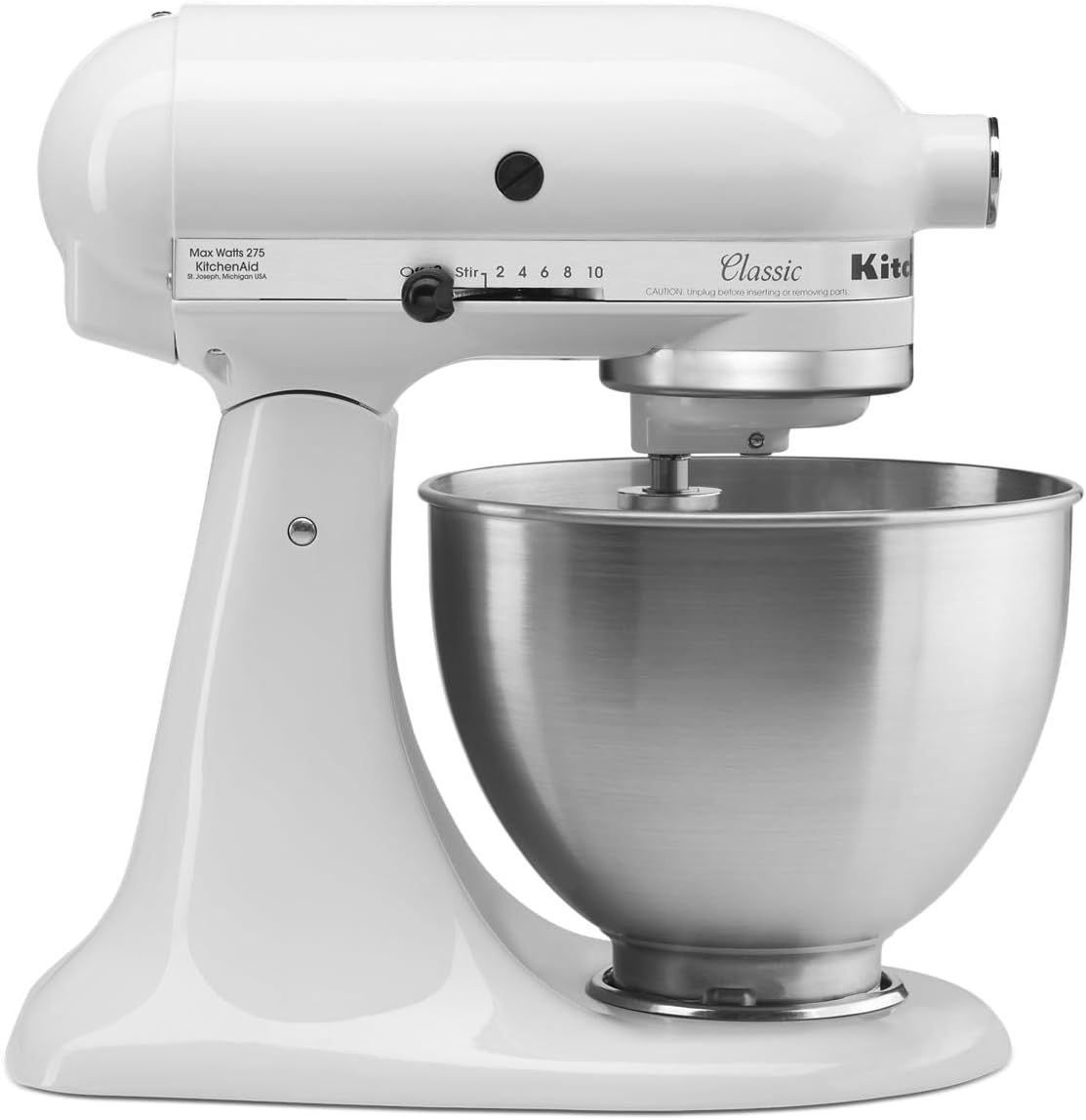 Visit on Amazon → Visit on Amazon →KitchenAid Classic Series 4.5 Quart Tilt-Head Stand Mixer K45SS, White |
4.5 quart | Tilt head | Cakes, cookies, single loaves | Check current Amazon price |
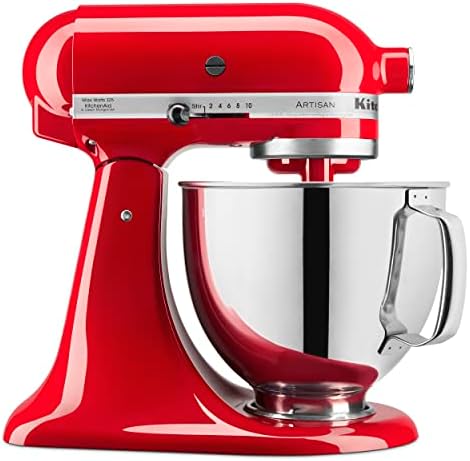 Visit on Amazon → Visit on Amazon →KitchenAid Artisan, 5-Qt Tilt Head Stand Mixer, KSM150PS, Empire Red |
5 quart | Tilt head | The household all-rounder | Check current Amazon price |
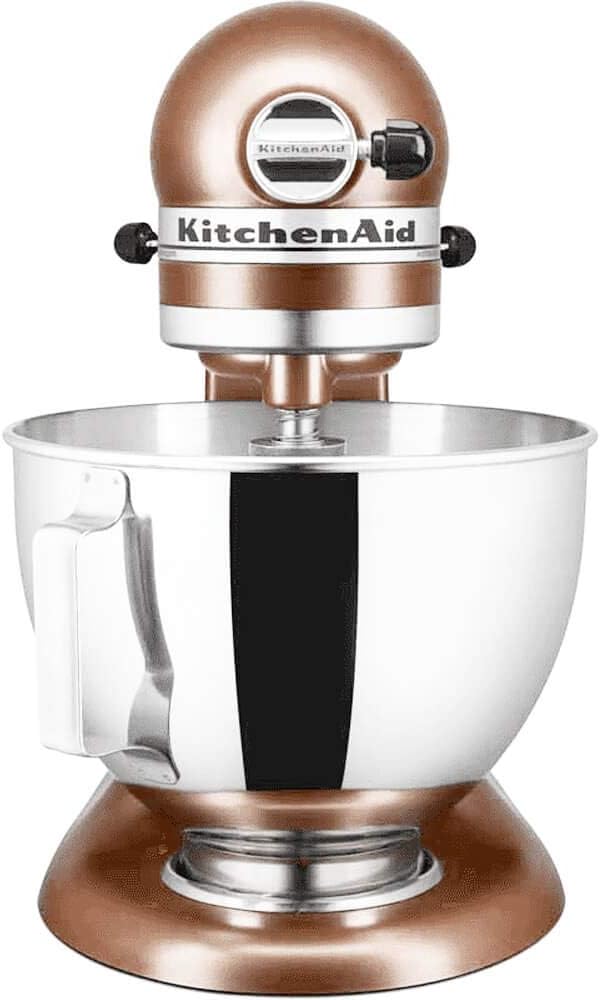 Visit on Amazon → Visit on Amazon →KitchenAid Classic 4.5 Quart, 10 Speed, Tilt Head Stand Mixer, Copper |
4.5 quart | Tilt head | The same Classic, left on display | Check current Amazon price |
 Visit on Amazon → Visit on Amazon →KitchenAid KSMPRA 3-pc Pasta Roller/Cutter Set for KitchenAid Stand Mixers |
Not a mixer | Hub attachment | Fresh pasta from your mixer | Check current Amazon price |
Should you buy the KitchenAid Artisan 5-Qt?
Yes, for most kitchens. The 5-quart bowl is the reason, because it is the size where you stop doing math before every bake. Cookies, cakes, frosting, one big loaf: it handles all of it, and the tilt head makes the in-between steps pleasant instead of annoying.
Be honest with yourself about bread, though. If your weekly bake is a stiff dough at double batch size, this mixer will do it and make you aware it is working. It is the best all-rounder, not the best bread machine, and those are different purchases.
Should you buy the KitchenAid Classic Series 4.5 Quart K45SS?
Yes, if your kitchen runs on cakes, cookies, and quick breads with an occasional loaf. It is lighter than the 5-quart machines, it stores easily, and the white finish keeps it out of the way until you need it.
The one thing to think about is capacity, because you cannot upgrade a bowl later. If you are already making two loaves a week, the 4.5-quart bowl will feel small by month two, and you will be shopping again. Buy the size of the bake you actually do, not the bake you plan to do someday.
Should you buy the KitchenAid KSMPRA pasta roller set?
Yes, if you own a KitchenAid stand mixer and you make pasta regularly. It mounts on the hub, rolls and cuts sheets of dough, and turns a mixer you already have into a second appliance. That is the best kind of kitchen purchase, the one that multiplies what you own instead of adding to the pile.
Skip it if pasta is a twice-a-year project. Attachments are the most expensive way to buy a tool you rarely use, and I say that as a man with a drawer full of proof.
The through line in all of this is simple. The motor is the mixer, the bowl is the limit, and the hub is the future. Pick the machine that matches the baking you actually do, and it will outlast the trend that sold it to you.