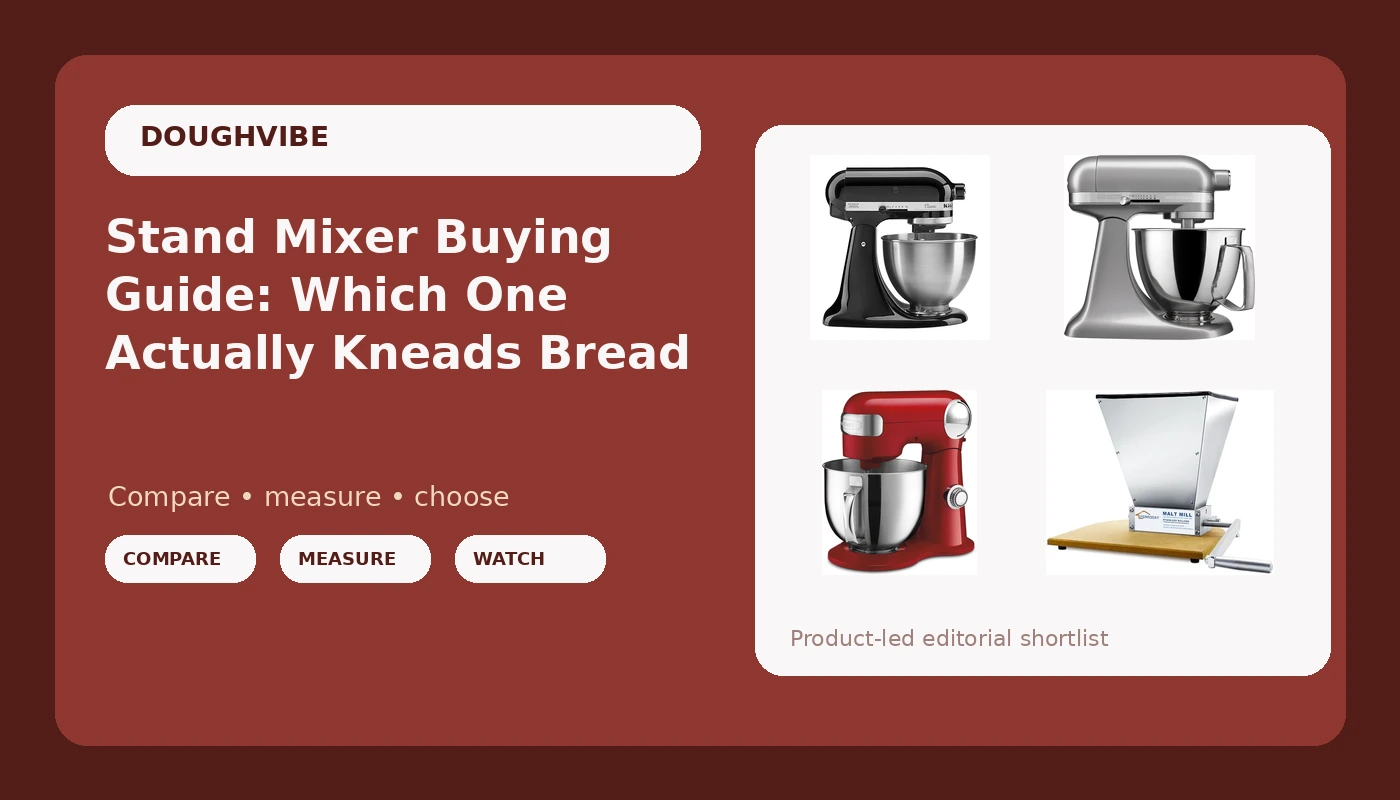
Choosing a stand mixer for bread dough is a different shopping problem than choosing one for frosting and whipped cream. The two jobs load the machine in opposite ways. Whipping cream asks for speed at the top of the range, while a stiff dough asks for torque at the bottom of it, and torque is the part no bowl measurement will ever tell you. That is why a mixer can look generous on the shelf and still feel outmatched the first time you push a two-pound batch of dough into it. This explainer sorts through four options that sit at different points on that spectrum, from a compact tilt-head mixer to a full-size 12-speed machine to a two-roller grain mill for bakers who begin their bread by milling the grain instead of buying it.
Related: How to Knead Bread Dough in a Stand Mixer Without Stalling the Motor →
Quick answer
There is no single winner here, because these four products do different jobs. If you want one mixer for everyday creaming, whipping, and moderate dough batches in the familiar tilt-head format, the KitchenAid Classic Series 4.5 Quart is the most conventional starting point. If counter space or batch size is the limiting factor in your kitchen, the KitchenAid Artisan Mini 3.5-Qt is built for smaller volumes. If you want the largest bowl in this group along with a full set of mixing tools included, the Cuisinart SM-50R is the one to look at. And if your bread begins with whole malted grain rather than a bag of flour, the FERRODAY two-roller mill addresses that step. None of these is the quietest, fastest, or objectively best; each is a different answer to a different constraint.
Four useful options
| Model | Best fit | What stands out |
|---|---|---|
| KitchenAid Classic Series 4.5 Quart Tilt-Head Stand Mixer K45SS | Everyday mixing and moderate dough batches | Tilt-head design with a 4.5-quart bowl on a long-running platform |
| KitchenAid Artisan Mini, 3.5-Qt Tilt Head Stand Mixer | Small kitchens and small batches | The smallest bowl in this group, in a compact tilt-head format |
| Cuisinart Stand Mixer, 12 Speed, 5.5 Quart Stainless Steel Bowl, SM-50R | Larger batches and a full tool set | 5.5-quart stainless bowl, 12 speeds, whisk, paddle, dough hook, and splash guard included |
| FERRODAY Malted Grain Mill, 2 Roller Stainless Steel | Milling your own malt and grain | Two stainless steel rollers; a mill rather than a mixer |
The everyday all-rounder: KitchenAid Classic Series 4.5 Quart Tilt-Head Stand Mixer K45SS
The Classic Series is the shape most people picture when they picture a stand mixer. A tilt head is convenient: you unlock it, the head swings up and back, and the bowl comes free without lifting anything heavy. The trade-off is mechanical. A head that pivots on a hinge has more places to move under load than a head that stays fixed, so if you routinely push dense, low-hydration dough into a tilt-head machine, you are asking more of that hinge than the design was built to give. For creaming butter, whipping egg whites, and mixing moderate batches of bread dough, it is a reasonable fit. For double batches of stiff dough, look at the bowl size honestly and consider whether you are better served by a bigger machine.
The small-batch pick: KitchenAid Artisan Mini, 3.5-Qt Tilt Head Stand Mixer
Small bowl, small batch. That is the whole logic of the Artisan Mini, and it is worth respecting rather than treating as a compromise. A 3.5-quart bowl is not the machine you buy to make four loaves at once. It is the machine you buy when you bake a single loaf or a single cake at a time and you would rather not surrender half a counter to a mixer you use twice a week. The honest caveat is the same one that applies to any smaller bowl: the dough capacity is lower than the liquid capacity, and stiff dough is where that gap shows up first. If your weekly bake is one boule and a batch of cookies, this is a sensible footprint. If it is a Saturday production run, it is the wrong tool.
The larger-bowl value pick: Cuisinart Stand Mixer, 12 Speed, 5.5 Quart, SM-50R
Two things separate the Cuisinart SM-50R from the KitchenAid machines above: bowl volume and what comes in the box. A 5.5-quart stainless bowl gives you headroom that a 3.5-quart or 4.5-quart bowl does not, and the included whisk, paddle, dough hook, and splash guard mean you are not budgeting for a separate attachment purchase before your first bake. Twelve speeds give you finer control between the slow end where dough comes together and the fast end where cream peaks. The caveat is the one that applies to every mixer at every price: bowl volume is not motor capability, and a large bowl can hold more dough than the machine comfortably kneads. Buy it for the volume and the included tools, then respect the batch sizes you actually run.
The grain-side companion: FERRODAY Malted Grain Mill, 2 Roller Stainless Steel
This one is not a mixer and should not be compared to one. It belongs in the article because it sits in the same workflow for a specific kind of baker: the person who buys malted grain or barley rather than a bag of ground flour and needs to crack it before anything else happens. A two-roller mill crushes grain between stainless rollers, which is a fundamentally different job from kneading. If you already own a mixer and your bread or brewing process starts with whole grain, this is the missing step. If you buy flour by the sack, it is not part of your decision at all, and no amount of mixer shopping will make it one.
Prices and availability may change. Product images, names, and retailer links are matched to verified listings. No current price, rating, stock status, or measured result is stated here without current evidence.
Bowl capacity and motor load are two different numbers
The quart rating on a mixer describes the bowl, not the machine's willingness to work. Manufacturers routinely publish a dough capacity that is lower than the bowl's liquid capacity, and that gap exists for a reason: stiff dough, the kind with low hydration, resists the hook with far more force than batter or cream ever will. Wattage tells you how much power the motor draws. Torque tells you whether that power turns into twisting force at the shaft when the dough pushes back. A mixer can have a generous bowl and a motor that gives up partway through a dense batch, and the bowl measurement will never warn you about it.
This is why the practical question is not "how many quarts" but "how heavy is my typical dough, and how often do I make it." A 5.5-quart bowl that comfortably handles your usual two-pound batch is a better purchase than a larger machine you never fill, and a smaller bowl that is always at its limit is a worse one than it looks on paper.
Tilt head versus lift bowl, and what it means for dough
There are two dominant head designs. A tilt-head mixer pivots the head up and back on a hinge at the rear, which makes the bowl easy to reach and the machine shorter to store. A lift-bowl mixer keeps the head fixed and raises the bowl on arms into it, which cradles the bowl more firmly and resists the rocking that heavy dough can induce.
All three mixers in this group use a tilt head, so within this comparison the design question is settled. What remains is how hard you push that design. A tilt head handles creaming, whipping, and moderate dough without complaint. Push it into repeated double batches of stiff dough and you are relying on a hinge to do a job a fixed cradle does better. If bread is most of what you bake, that is worth knowing before you buy rather than after.
- Decide what share of your baking is actually bread, not what share you intend it to be.
- Match the bowl to your typical batch size rather than your largest imagined one.
- Check whether the head design suits the stiffness of the dough you make most often.
- Count the attachments included in the box before you price the ones you will need separately.
- If your process starts with whole grain, plan the milling step as its own purchase.
Practical guidance for buying
- Write down the dough you make most often, in pounds, before you compare any bowl sizes.
- Treat the quart rating as a ceiling for liquid and a rough guide for dough, never as a promise.
- Budget for the tools, not just the machine: a whisk, a paddle, and a dough hook are the working parts.
- Measure your counter and your cabinet clearance if storage matters as much as mixing.
- If you mill your own grain, buy the mill as a separate decision from the mixer, because it is one.
Which option should you choose?
Choose the KitchenAid Classic Series 4.5 Quart Tilt-Head Stand Mixer K45SS when you want one familiar tilt-head machine for everyday mixing and moderate dough batches. Choose the KitchenAid Artisan Mini, 3.5-Qt Tilt Head Stand Mixer when counter space or single-batch baking is the real constraint. Choose the Cuisinart Stand Mixer, 12 Speed, 5.5 Quart Stainless Steel Bowl, SM-50R when you want the largest bowl here and the mixing tools included from the start. And choose the FERRODAY Malted Grain Mill when your process begins with whole malted grain or barley rather than flour.
One caveat applies across all four: nothing here is a claim about measured performance, motor durability, or how any machine behaves after months of use. The distinctions above come from what each product is and what it includes, which is the part you can verify before you buy.
The bottom line
The right stand mixer for bread dough is the one whose bowl and head design match the batches you actually make, not the batches you plan to make someday. For most kitchens, the KitchenAid Classic Series 4.5 Quart covers everyday mixing in the format people already know. The Artisan Mini trades capacity for footprint. The Cuisinart SM-50R gives you the largest bowl and a complete set of tools. The FERRODAY mill is a separate purchase for a separate step, and only you know whether that step is part of your baking. Check current Amazon price on the ones that fit your counter, your batch size, and your dough.