Related: How to Tell If Your Mixer Can Handle Bread Dough
I kneaded dough by hand for years before I admitted a machine could do it better. My wrists gave out long before my interest did. Since then I have run home mixers through the same punishment: sourdough, brioche loaded with butter, and the same question every single time, does the motor survive the fifth loaf. A stand mixer for bread dough is a different machine than a stand mixer for cake batter, and most of what you read about them was written by someone who never put a stiff dough in the bowl.
Two things decide whether a mixer earns its counter space. The motor, because torque is what moves a stiff dough and wattage is only a hint at it. And the bowl geometry, because a big bowl with a small batch leaves the dough hook spinning in air while the dough sits in a lump at the bottom. Everything else, the color, the speed dial, the little recipe booklet, is decoration.
That is the lens I used on the three products below. One is built for dough, one is built for small batches of everything else, and one is not a mixer at all but belongs in the conversation anyway.
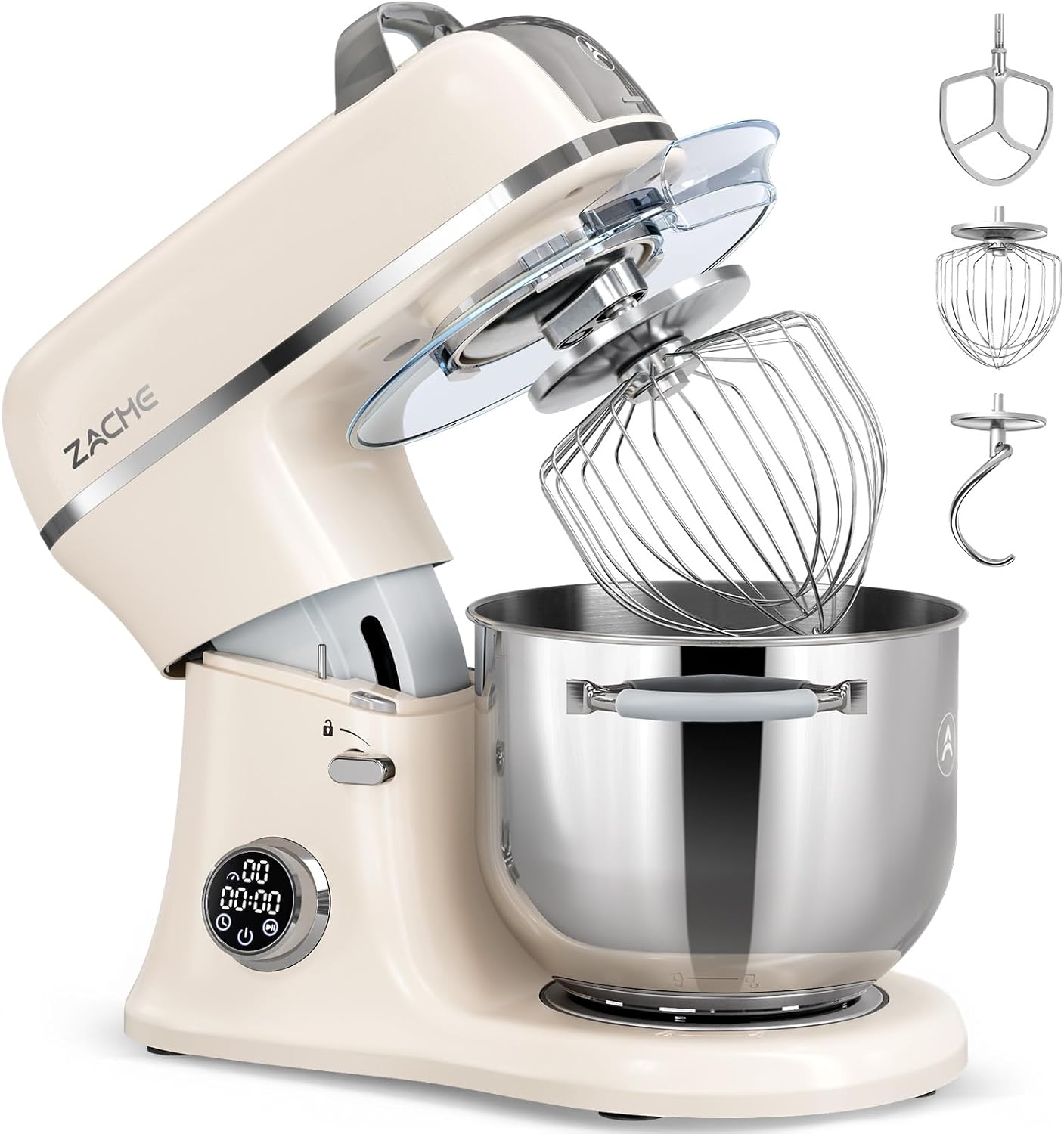
Best for bread dough: ZACME 7 Quart Stand Mixer
The ZACME lists 650 watts, 12 speeds, a 7-quart stainless steel bowl, a tilt-head design, an aluminum die-cast body, and it comes with a dough hook, a whisk, and a beater. Read that list the way a bread baker reads it and the dough hook is the headline. Plenty of compact mixers ship with a whisk and a beater and call it a set. A dough hook is the attachment that tells you the manufacturer expected you to knead.
650 watts clears the floor I use for bread. Below 500 watts you are buying a whipping machine with ambitions, and no amount of bowl size fixes that. The die-cast aluminum body matters for a less obvious reason: mass. A light mixer walks across the counter when a stiff dough starts fighting back. A heavy one stays put, and staying put is half of kneading.
The 7-quart bowl is where you have to think. Seven quarts is a lot of volume, and dough needs to stay in contact with the hook rather than park itself at the bottom of a cavern. If you bake two loaves at a time, that bowl is exactly right. If you bake one small loaf a week, you will spend a good part of the knead pushing dough back toward the middle, which is the kind of thing that sounds minor until you do it fifty times.
Tilt head is the other tradeoff. I have said for years that lift bowl beats tilt head for bread people, because the bowl on a lift design sits down in a fortress and a tilt head is a hinge. That said, tilt head is easier to load and easier to scrape, and on a mixer with enough mass the wobble is manageable. Watch the head during the first stiff dough you make. If it is bouncing, you found the limit.
Best for small kitchens: Dash Everyday Stand Mixer
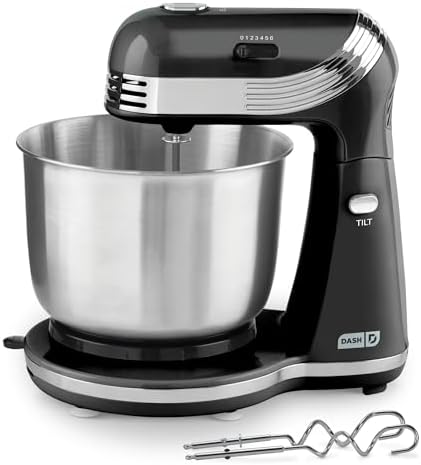
The Dash Everyday lists 6 speeds, a 3-quart stainless steel bowl, a tilt-head design, and a compact footprint in red. It is a small mixer and it is honest about being one, which I respect more than a big bowl bolted onto a weak motor.
Here is the arithmetic a bread baker has to do. A 3-quart bowl is a small-batch bowl. That is the bowl for one small loaf, a batch of cookies, a pint of whipped cream, or pancake batter on a Sunday morning. It is not the bowl for a two-pound dough that needs room to move. Try a big batch in a small bowl and the dough climbs the hook, then climbs out of the bowl, and you spend the next twenty minutes cleaning the counter instead of shaping bread.
Six speeds on a compact machine is fine for the job this mixer was built for: cakes, cookies, quick breads, frosting, whipped cream, mashed potatoes. If your baking life is mostly those things with bread once a month, this is a reasonable, space-friendly machine at a fraction of what the big mixers cost. If your baking life is a weekly sourdough and a monthly brioche, this is not the mixer, not because it is bad but because it was not built for that load. Buy the tool that matches the loaf you actually make.
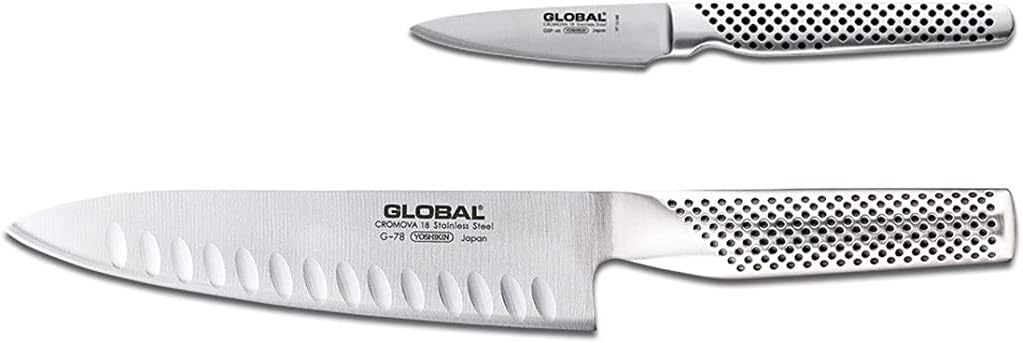
The knife that takes over: Global 2 Piece Cook's Set G-78 & GSF-46
This one is not a mixer and I am not going to pretend it kneads anything. It is here because a mixer only gets dough to the point where a knife takes over. You divide a bulk ferment, you score a boule, you slice the finished loaf, and the tool doing that work gets touched more often than any attachment on the machine.
The Global set is a two-piece cook's set, the G-78 and the GSF-46, and it is the kind of purchase that outlives three mixers. Global blades are thin and light, a feel people either love or find too light in the hand, and the handle shape takes a day or two to get used to. What I care about in a bread kitchen is a blade thin enough to score a proofed loaf without dragging the skin, plus a smaller companion knife for trimming dough or cutting a brioche into portions.
If you already own a chef's knife you like, this is not the purchase that fixes your bread. If you are still dividing dough with a butter knife, it is. Budget your money in this order: motor first, then bowl size, then the knife.
How I test a mixer
I run the same 60-day gauntlet on every machine that comes through my kitchen. Same sourdough, same brioche, same question about whether the motor survives the fifth loaf. Sixty days is long enough for the honeymoon to end and for the flaws to show up.
The stiff dough test comes first. A low-hydration dough, the kind that fights back on the hook. If the mixer stalls, the marketing lied, and the bowl size printed on the box stops mattering. If the head wobbles under load, I write that down. If the machine walks across the counter, I write that down too.
The smell test comes second. Ten minutes of kneading, then I put my face near the motor housing. If it smells hot, the motor is working past what it was built for, and that is a mixer I would not trust with a decade of weekly bread. A warm smell is normal. A hot, electrical smell is a warning, and I have sent machines back over it.
The repeat test comes third, and it is the one that separates the keepers. The fifth loaf, not the first. Any mixer can handle loaf number one, when everything is clean and exciting. The machine you want behaves the same way on loaf fifty, with the same sound and the same temperature at the housing. That is the difference between a mixer that lasts a decade and one that dies in year two.
And then the cleanup test, which nobody writes about. A dough hook that releases dough instead of holding onto it, and a bowl that fits in the sink, matter more on a Tuesday night than any number on a spec sheet.
What the specs actually tell you
Wattage is a hint, torque is the answer. A 650-watt motor with good gearing kneads better than a 700-watt motor with cheap gearing, and no box tells you which one you are holding. What you can do is look for the dough hook. A manufacturer that ships a dough hook expects dough, and the ZACME ships one.
Bowl capacity is a lie told in the direction of optimism. A mixer advertised as a 5-quart machine that stalls on two pounds of bread dough has a marketing problem, not a capacity problem. The number that matters is not how much liquid a bowl holds, it is how much dough the motor can push through a full knead without getting hot. Those two numbers are almost never the same, and only one of them shows up in the listing.
Lift bowl versus tilt head is a real decision for bread people. The lift design puts the bowl on two arms and locks it down, which is a fortress. The tilt head is a hinge, and hinges wobble. If you make bread more than once a week and you can afford the lift design, it earns its keep. If you bake cakes and cookies with bread now and then, tilt head is easier to live with, and both mixers in this guide are tilt-head machines.
Attachments decide the long-term relationship. A mixer with a pasta roller and a grinder is a kitchen system. A mixer with a proprietary port and nothing to plug into it is a gadget. Look at what is actually available for the machine before you buy, not after. If the attachments cost more than the mixer, you have your answer about the ecosystem.
And the floor: skip anything under 500 watts if bread is the plan. That is not a rule about brands. It is a rule about physics.
Stand mixer reference table
This is the table I would tape inside a cabinet door if these three were the choices in front of me. The specs are what the listings state. The notes are what those specs mean once a loaf of bread is involved.
| Product | Best for | Listed specs | What it means for bread |
|---|---|---|---|
 Visit on Amazon → Visit on Amazon →ZACME 7 Quart Stand Mixer |
Bread dough and larger batches | 650W, 12 speeds, 7-quart stainless bowl, tilt-head, die-cast aluminum, dough hook, whisk, beater | The only mixer here with a dough hook, and the only one with the wattage for a stiff dough. Big bowl, so match your batch size to it |
 Visit on Amazon → Visit on Amazon →Dash Everyday Stand Mixer |
Cakes, cookies, small batches | 6 speeds, 3-quart stainless bowl, tilt-head, compact | A small-batch machine. Fine for one small loaf or a batch of cookies, not for a two-pound dough |
 Visit on Amazon → Visit on Amazon →Global 2 Piece Cook's Set |
Dividing, scoring, slicing | Two-piece set, G-78 and GSF-46 | Not a mixer. The knives that take over once the dough leaves the bowl |
Check current Amazon price: ZACME 7 Quart Stand Mixer, Dash Everyday Stand Mixer, Global 2 Piece Cook's Set.
Should you buy the ZACME 7 Quart Stand Mixer?
Yes, if bread is the reason you are shopping. It has the wattage, it ships with the dough hook, and the die-cast body gives it the mass to sit still while a stiff dough fights back. The 7-quart bowl is a genuine advantage when you bake two loaves at a time, and a genuine annoyance when you bake one small one. The tilt head is the compromise, so watch the head during your first heavy knead. If it bounces, you found the ceiling.
Should you buy the Dash Everyday Stand Mixer?
Yes, if your kitchen is small and your baking is mostly cakes, cookies, frosting, and quick breads. It is a compact, honest machine, and for whipped cream and cookie dough it will do everything you ask. No, if you plan a weekly sourdough, because a 3-quart bowl is a small-batch bowl and a compact motor is a compact motor. Buy the tool for the loaf you actually make.
Should you buy the Global 2 Piece Cook's Set?
Yes, if you do not own a knife you enjoy. A mixer handles the knead, but a knife handles the divide, the score, and the slice, and those are the steps where a bad tool shows up in the crumb. No, if you already have a chef's knife you trust, because this is a want, not a fix. Motor first, bowl size second, knife third.
The bottom line
One machine here is built to knead, one is built to be small, and one is not a machine at all. Decide which loaf you actually bake, then buy the tool that matches it, and check the motor housing after ten minutes of dough. If it smells hot, you bought the wrong one.