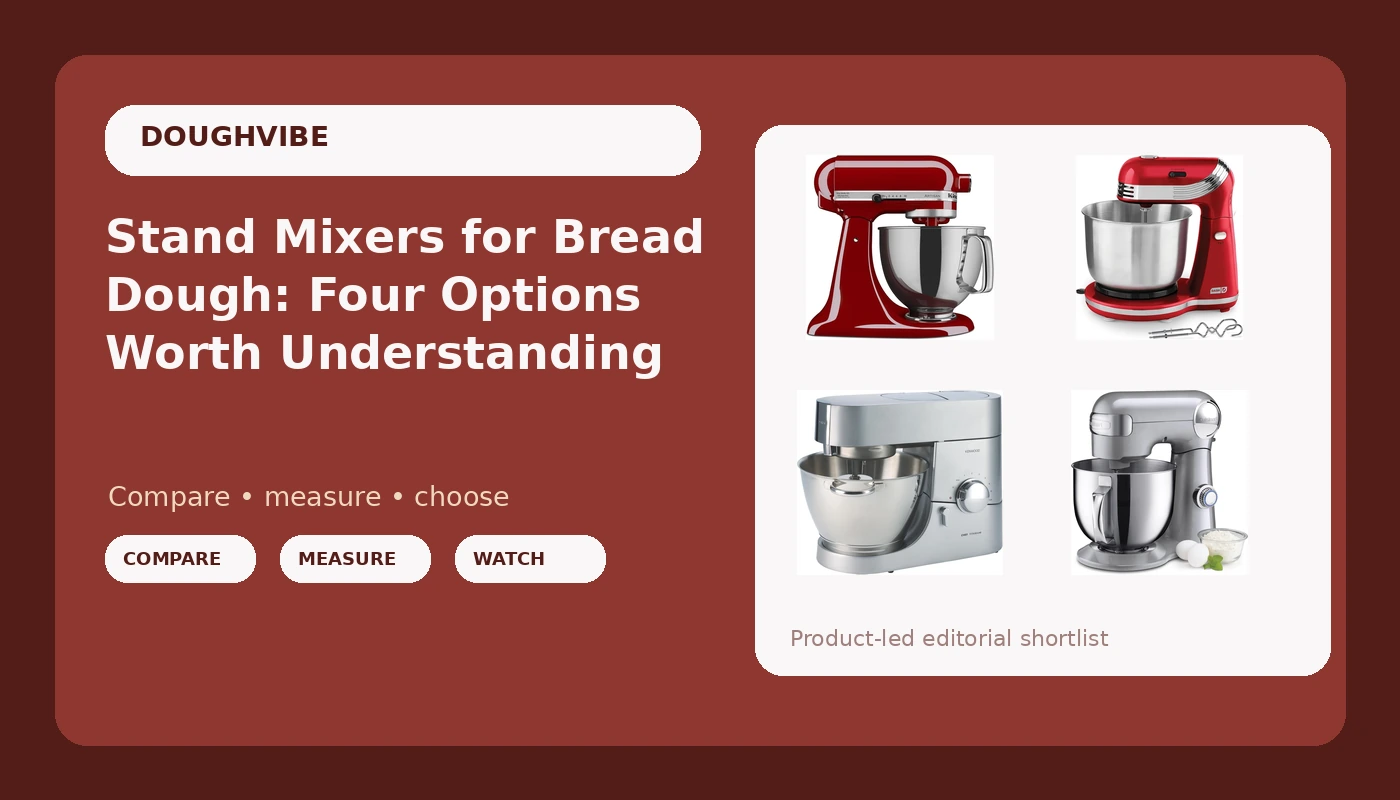
Choosing among stand mixers for bread dough is a different exercise from choosing among mixers for cake batter, and the difference is load. Buttercream is light and forgiving. A stiff dough fights the machine for every rotation, and it fights hardest at the moment when the hook is buried and the dough has stopped being a loose mass. That is where a mixer's real character shows: in the motor, in the gearing, and in how rigidly the bowl is held in place while the hook climbs through the dough.
Most buyers start with bowl size, because bowl size is the number printed largest on the box. It is also the easiest specification to sell and one of the least useful on its own. A 5-quart mixer that stalls on two pounds of dough and a 5-quart mixer that handles it without complaint are sold as the same capacity class and behave nothing alike. The four options below sit at different points on that spectrum, and each one suits a different kind of kitchen.
Related: Tilt-Head vs Fixed-Head Mixers: What Actually Changes Under Stiff Dough →
Quick answer
Match the machine to the dough you actually make, not to the biggest number on the box. For cookies, cakes, frostings, and the occasional loaf, a 3-quart or 5-quart tilt-head mixer is enough, and the KitchenAid Artisan and the Dash Everyday both fit that brief at different sizes. If stiff bread dough is a weekly habit, read the motor rating and the bowl mounting before anything else. The Kenwood Chef Titanium lists an 800-watt motor with electronic variable speed control. The Cuisinart lists 12 speeds and a 5.5-quart bowl with a full set of mixing tools. The KitchenAid Artisan lists a 5-quart tilt-head design, and the Dash lists a 3-quart bowl with 6 speeds.
Those are manufacturer specifications, not test results. What they tell you is what each machine is built to attempt, not how it behaves at minute eight of a stiff dough. Treat the numbers as a filter for your shortlist, then confirm the details on the product page before you buy.
4 useful options
| Model | Best fit | What stands out |
|---|---|---|
| KitchenAid Artisan, 5-Qt Tilt Head Stand Mixer, KSM150PS, Empire Red | All-purpose home baking | 5-quart bowl with a tilt-head design |
| Dash Everyday Stand Mixer, 3-Quart | Small kitchens and small batches | 6 speeds and a compact 3-quart stainless steel bowl |
| Kenwood Chef Titanium Kitchen Machine | Stiff dough and precise speed control | 800W motor, electronic variable speed control, dishwasher-safe work bowl |
| Cuisinart Stand Mixer, SM-50BCNAS | Larger batches and a complete starter tool set | 12 speeds, 5.5-quart bowl, whisk, paddle, dough hook, splash guard |
The all-rounder: KitchenAid Artisan, 5-Qt Tilt Head Stand Mixer, KSM150PS, Empire Red
Five quarts is a genuinely useful all-purpose size. It handles a single cake, a batch of cookie dough, and a standard loaf without forcing you to scale recipes up or down. The tilt-head design is a convenience feature with real consequences: lifting the head gives you open access to the bowl for scraping and adding ingredients, which matters more than it sounds when you are working with a thick dough that clings to the hook. The trade-off is structural. A tilt head relies on a hinge and a locking mechanism, and under a heavy load that assembly has more places to move than a fixed head does.
Note also what the listing does not advertise: a wattage figure. If raw motor rating is the deciding factor for you, that gap is something to weigh, and it is worth checking the product page for the details that matter to your baking. For cakes, cookies, and moderate bread schedules, the capacity and the design do the work. For a household that bakes two-pound loaves every week, the spec sheet leaves a question open.
The compact option: Dash Everyday Stand Mixer, 3-Quart
A 3-quart bowl is roughly sixty percent of a 5-quart bowl, and that ratio changes what recipes you can run without splitting them. Cake batter, frosting, whipped cream, pancake batter, and small batches of cookie dough are all comfortable here. A standard two-loaf bread recipe is not: the dough would fill the bowl to the point where it climbs the hook and pushes against the head, and a compact mixer asked to knead at that volume is working well outside the job it was designed for.
The reason to consider this class of mixer anyway is counter space. If your kitchen has one clear stretch of counter and no room to store a full-size machine, a compact mixer that lives on the counter and gets used twice a week beats a larger mixer that lives in a cabinet and gets used twice a month. Six speeds give you enough control for creaming butter and whipping egg whites without asking the machine to do anything structural. Choose it for the size of your kitchen and the size of your batches, not because you expect it to knead bread the way a heavier machine does.
The 800-watt option: Kenwood Chef Titanium Kitchen Machine
Wattage is not torque, and it is worth being precise about that. Wattage describes how much power the motor draws. Torque describes the twisting force delivered to the hook, and it depends on the motor, the gearing, and the control electronics working together. An 800-watt rating is a signal about the class of machine and the work it was built to do, not a guarantee about how it will handle any particular dough. What it does tell you is that this mixer is specified for heavier duty than a compact 3-quart unit.
Electronic variable speed control is the more quietly useful feature. Instead of a fixed set of steps, the speed adjusts continuously, which lets you start a stiff dough slowly and bring it up as the gluten develops rather than jumping straight to a speed that throws flour across the counter. The dishwasher-safe work bowl and the three included mixing tools are practical additions: a bowl you can put in the dishwasher after a bread bake removes one of the small annoyances that makes people stop baking bread at home.
The listing emphasizes the motor and controls rather than a tilt-head design, so if you have a strong preference for tilting the head back to add ingredients, confirm that detail on the product page before deciding.
The multi-tool option: Cuisinart Stand Mixer, SM-50BCNAS
The 5.5-quart bowl is the largest in this group, which matters if you routinely double a recipe or bake for a crowd. Twelve speeds is more granularity than most bakers need, but the low end of that range is where the value sits: a genuinely slow start lets a stiff dough come together before the hook starts working it hard.
The included tool set is the other argument. Buying a whisk, a paddle, and a dough hook separately adds up, and having all three from the start means you can move between whipped cream, creamed butter, and a kneaded dough without another purchase. The splash guard with a pour spout is the kind of accessory people dismiss until they add flour to a running mixer and then spend ten minutes wiping down the counter.
The trade-off is the size itself. A 5.5-quart bowl is a lot of bowl for a single batch of muffins, and the machine takes up correspondingly more counter or cabinet space. If your batches are small and your storage is tight, the extra capacity is weight you carry without using.
Prices and availability may change. Product images, names, and retailer links must be matched by verified ASIN. Do not state a current price, rating, stock status, or measured result without current evidence.
What motor ratings actually tell you
The single most common mistake in buying a mixer for bread is treating wattage as a complete answer. Wattage is power draw, measured at the wall. It sets a ceiling on what the machine can do, but the delivered force at the hook depends on gearing and motor design, which is why two mixers with similar ratings can behave very differently under the same dough.
There is also a practical limit that no rating captures: heat. A motor working near its ceiling for a long stretch builds heat, and heat is what eventually damages windings and bearings. This is why a lighter-duty mixer can whip cream for ten minutes without complaint and then struggle through the same ten minutes of stiff dough. The load is different, and so is the heat.
The honest way to read a specification is as a description of intent. An 800-watt rating says the machine was built for heavier duty. A 3-quart bowl with six speeds says it was built for smaller, lighter jobs. Neither statement predicts the outcome of your specific loaf, but both narrow the field usefully before you look at anything else.
Tilt head, fixed head, and what bowl capacity hides
A tilt-head mixer lifts the head away from the bowl on a hinge. A fixed-head design keeps the head in place and raises the bowl instead. The practical difference shows up under load. A fixed head has fewer moving parts between the motor and the bowl, and less opportunity for flex when a stiff dough pushes back. A tilt head is easier to load, scrape, and clean around, which is why it dominates the home market.
Bowl capacity is the other specification that needs translating. Quoted capacity usually describes the bowl's volume, not the amount of dough the machine can knead. A bowl filled to its stated capacity with bread dough would be overflowing in practice, because dough climbs the hook and expands as it develops. Treat a quoted capacity as roughly two-thirds usable for dough and you will avoid most of the disappointment that comes with a new mixer.
Five steps to narrow the field
- Write down the heaviest thing you actually mix in an average month. If it is cake batter, a compact mixer is enough. If it is two pounds of bread dough, that is a different machine.
- Check the motor rating before the bowl size, and read it as a class indicator rather than a promise.
- Decide whether you want a tilt head for loading convenience or a fixed head for rigidity under load.
- Count the tools included. A mixer that arrives with a whisk, a paddle, and a dough hook saves you three separate purchases.
- Measure your counter and your cabinet before you order. The largest bowl in this group is 5.5 quarts, and that size has to live somewhere.
Practical guidance
- Start every stiff dough on the lowest speed available and let the flour hydrate before you increase it.
- Stop and scrape down the bowl once or twice during kneading so the hook works the whole mass instead of one channel.
- Respect the dough limit implied by the bowl, not the number on the box. Around two-thirds of quoted capacity is a reasonable working maximum for bread.
- Feel the mixer housing after a long knead. Warm is normal; uncomfortably hot is a signal to give it a rest.
- Match the tool to the job: whisk for eggs and cream, paddle for butter and batter, dough hook for anything with gluten development.
Which option should you choose?
Choose the KitchenAid Artisan, 5-Qt Tilt Head Stand Mixer, KSM150PS, Empire Red when you want one 5-quart machine for general baking and you value being able to tilt the head back for easy loading and scraping. Choose the Dash Everyday Stand Mixer, 3-Quart when counter space is the constraint and your recipes are small, light, and frequent. Choose the Kenwood Chef Titanium Kitchen Machine when stiff dough is a regular part of your week and you want the motor rating and continuous speed control to match. Choose the Cuisinart Stand Mixer, SM-50BCNAS when you want the largest bowl in the group and a complete set of tools without buying them separately.
One caveat applies to all four. The specifications here come from manufacturer listings, not from bench testing, and no listing describes how a specific machine behaves under your specific dough. Confirm the details that matter most to you on the product page before you commit, particularly motor rating, head design, and what tools ship in the box.
The bottom line
For bread bakers, the motor and the bowl mounting are the decisions that matter, and bowl capacity is the one that gets the most marketing attention. If your baking leans toward cakes, cookies, and the occasional loaf, the KitchenAid Artisan and the Cuisinart offer the most general-purpose capacity, while the Dash keeps a small kitchen in the game. If stiff dough is the point, the Kenwood's listed 800-watt motor and variable speed control put it in a different conversation. Whichever you pick, buy for the heaviest dough you actually make rather than the lightest one you might, and check the current specification list before you order.