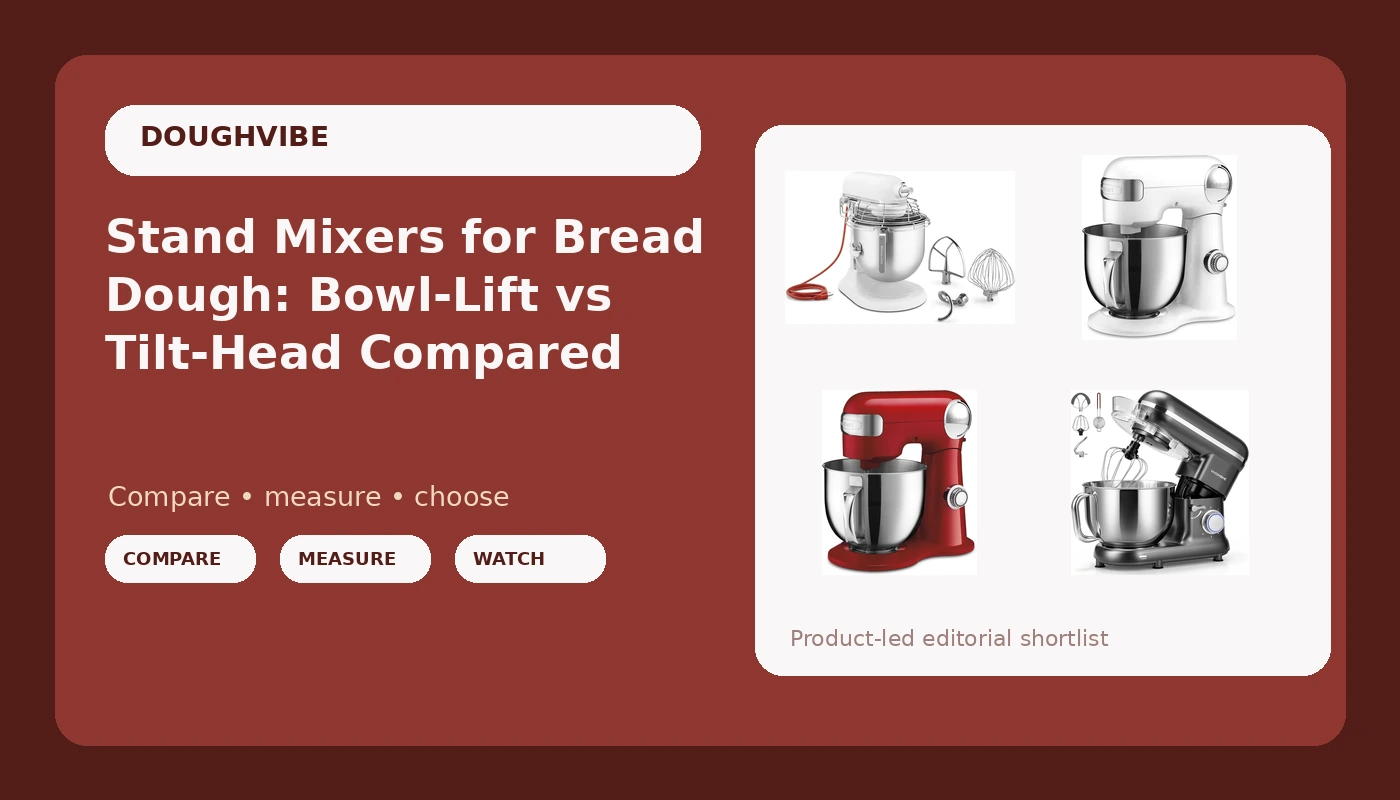
Stand mixers for bread dough are sold on bowl size, and bowl size is the least honest number on the box. A mixer can advertise a generous bowl and still bog down the moment you load it with a stiff two-pound loaf. What separates a machine that kneads from a machine that merely stirs is the motor, the geometry of the bowl, and the way the head or the bowl is held steady while the dough pushes back. This guide walks through four currently available mixers at very different price points, explains what each design choice actually changes at the counter, and helps you match a machine to the bread you really make.
Related: How Motor Power and Bowl Geometry Decide What a Mixer Can Knead →
Quick answer
If you bake bread often and want one machine that can take a large batch without drama, a bowl-lift design with a big stainless bowl, such as the KitchenAid Commercial Series 8 Quart Bowl-Lift Stand Mixer, is the shape to look for. If your baking leans toward cakes, cookies, buttercream, and the occasional enriched dough, a 5.5-quart tilt-head Cuisinart or a 6-quart VIVOHOME covers that work at a much lower cost. The deciding factor is not the number of quarts printed on the carton, but whether the motor and the bowl mounting can handle stiff dough repeatedly.
Four useful options
| Model | Best fit | What stands out |
|---|---|---|
| KitchenAid Commercial Series 8 Quart Bowl-Lift Stand Mixer with Stainless Steel Bowl Guard - KSMC895 | Frequent baking in large batches | 8-quart bowl-lift design with a stainless steel bowl guard |
| Cuisinart Stand Mixer, 12 Speed, 5.5 Quart, White Linen, SM-50NAS | Everyday home baking | 12 speeds, 5.5-quart stainless bowl, whisk, paddle, dough hook, splash guard |
| Cuisinart Stand Mixer, 12 Speed, 5.5 Quart, Ruby Red, SM-50R | Everyday home baking, different finish | Same 5.5-quart, 12-speed setup and the same tool set in red |
| VIVOHOME Stand Mixer, 6-Quart Tilt-Head, Gray | Smaller kitchens and lighter doughs | 6-quart tilt-head capacity with a bowl included |
The bowl-lift bread machine: KitchenAid Commercial Series 8 Quart Bowl-Lift Stand Mixer with Stainless Steel Bowl Guard - KSMC895
The bowl-lift geometry is the part worth understanding. On a lift design, the bowl sits in a cradle and cranks upward into the head, so the mass of the dough is supported by the frame rather than hanging off a hinge. That matters when a dough is stiff enough to resist the hook, because the force has somewhere solid to go. Eight quarts also changes batch size: this is a mixer for people who divide dough for several loaves at once, or who bake in quantities that would overflow a standard home bowl. The trade-offs are real and physical. A machine this size needs counter space, headroom to raise the bowl, and a storage plan, and it is heavier than a tilt-head of the same footprint.
The all-purpose tilt-head: Cuisinart Stand Mixer, 12 Speed, 5.5 Quart Stainless Steel Bowl, Chef's Whisk, Mixing Paddle, Dough Hook, Splash Guard w/ Pour Spout, White Linen, SM-50NAS, Manual
This is the profile most home bakers picture when they hear "stand mixer." The head tips back for access to the bowl, the tools swap out quickly, and 5.5 quarts is a genuinely useful size for a two-loaf batch of sandwich bread or a double batch of cookies. The tool set covers the three core jobs without an extra purchase: whisk for cream and egg whites, paddle for batters and cookie dough, dough hook for yeast dough. The honest limitation of any tilt-head is that the head pivots, so a very stiff dough can make the assembly work harder than a bowl-lift frame would. That is not a defect, it is the design. If your doughs are moderately hydrated and your batches are home-sized, the tilt-head is easier to live with day to day.
The same mixer in red: Cuisinart Stand Mixer, 12 Speed, 5.5 Quart Stainless Steel Bowl, Chef's Whisk, Mixing Paddle, Dough Hook, Splash Guard w/ Pour Spout, Ruby Red, SM-50R, Manual
It is worth saying plainly that these two Cuisinart listings describe the same machine. The model numbers differ, the color differs, and that is the whole story: same 12 speeds, same 5.5-quart stainless bowl, same whisk, paddle, dough hook, and splash guard. So there is no performance argument to make between them. Color variants can move in and out of stock on different schedules, and pricing on two listings of one machine does not always track together, which is the only practical reason to compare them side by side. Pick the finish you want, then check what the listing looks like that week. Do not pay a premium for a color unless the color is genuinely the point for you.
The budget tilt-head: VIVOHOME Stand Mixer, 6-Quart Tilt-Head Kitchen Mixer with Bowl, Gray
The VIVOHOME is the least expensive way into this group, and the spec sheet is honest about what it is: a 6-quart tilt-head with a bowl in the box. Six quarts is more bowl than the Cuisinart offers, which sounds like an advantage until you remember that capacity and capability are different things. A larger bowl on a lighter-duty tilt-head does not automatically mean bigger bread batches; it means more room for cake batter, frosting, and cookie dough, and a bowl that can hold a generous batch of wetter dough. For someone whose baking is mostly desserts with bread as an occasional weekend project, that is a reasonable trade. For someone planning a weekly sourdough habit, it is the wrong tool, and no bowl size fixes that.
Prices and availability may change. Product images, names, and retailer links are matched to verified listings. No current price, rating, stock status, or measured result is stated here without current evidence.
What bowl-lift and tilt-head really change
The two layouts solve the same problem in different ways, and the difference shows up under load. A tilt-head mixer pivots the motor and head assembly backward on a hinge for bowl access. That hinge is a moving joint, and a moving joint flexes. With soft dough, buttercream, or cake batter, the flex is irrelevant. With a stiff, low-hydration dough, the hook meets real resistance and the head wants to move with it, which is why a tilt-head can feel like it is working harder than the job requires.
A bowl-lift mixer keeps the head fixed and raises the bowl on arms into the tools. The frame absorbs the force instead of a hinge, and the bowl sits in a locked cradle rather than on a rotating base. That is why bakeries and heavy home bakers gravitate to the design, and why lift-bowl machines tend to be heavier and taller. The cost is ergonomics: you cannot simply tip the head back, and you need clearance above the mixer to crank the bowl up. Neither layout is superior in the abstract. The layout has to match the dough you make most often.
Why motor power matters more than bowl size
Bowl size tells you how much the mixer can hold. Motor strength tells you what it can actually work. Those two numbers are marketed as if they were the same thing, and they are not. A mixer can have a deep bowl and a motor that stalls when a dough gets stiff, and the stall shows up as the hook slowing, the machine heating, and eventually a smell that means the motor is being asked for more than it can give.
Two things follow from that. First, ignore any mixer, regardless of bowl size, that is sold on capacity alone with no meaningful power behind it. Second, understand that whipping and kneading are different jobs. A mixer that turns cream into stiff peaks in ninety seconds is doing easy work, because cream offers almost no resistance. Stiff bread dough resists everything. A machine that is brilliant at one can be mediocre at the other, which is why "it whips great" is not evidence that it kneads well.
If you want a repeatable way to judge a mixer before you commit, work through this:
- Decide what you bake most: cakes and cookies, enriched doughs, or lean bread doughs.
- Estimate your largest realistic batch, not your dream batch, in pounds of dough or quarts of batter.
- Match the layout to that batch: tilt-head for lighter, home-sized work, bowl-lift when the dough gets stiff or the batches get large.
- Check what tools come in the box, since a dough hook you have to buy separately changes the real cost.
- Plan for the space and weight, because a big bowl-lift mixer needs counter room, headroom, and a place to live.
Matching a mixer to the bread you actually bake
- Weekly lean bread dough in two-pound batches is the job that separates mixers, and it is the job where a fixed-head bowl-lift frame earns its footprint.
- Enriched doughs with butter, eggs, and sugar are softer and more forgiving, so a 5.5-quart or 6-quart tilt-head is a sensible match.
- Cakes, frosting, and cookie dough rarely stress a motor, which is why a mid-priced tilt-head with a full tool set covers most home kitchens.
- Large households and batch bakers should think in bowls of dough rather than loaves, since an 8-quart bowl changes how many loaves one session can produce.
- If your baking is seasonal, a smaller tilt-head you can leave on the counter will get used more than a heavy machine you have to haul out.
Which option should you choose?
Choose the KitchenAid Commercial Series 8 Quart Bowl-Lift Stand Mixer with Stainless Steel Bowl Guard - KSMC895 when bread is a regular habit, your batches are large, and you want a fixed head and a big stainless bowl doing the work. Choose the Cuisinart Stand Mixer, 12 Speed, 5.5 Quart Stainless Steel Bowl, Chef's Whisk, Mixing Paddle, Dough Hook, Splash Guard w/ Pour Spout, White Linen, SM-50NAS, Manual when you want one all-purpose machine with the core tools included and your doughs are home-sized. Choose the Cuisinart Stand Mixer, 12 Speed, 5.5 Quart Stainless Steel Bowl, Chef's Whisk, Mixing Paddle, Dough Hook, Splash Guard w/ Pour Spout, Ruby Red, SM-50R, Manual when that same machine is the right fit and you prefer the red finish. Choose the VIVOHOME Stand Mixer, 6-Quart Tilt-Head Kitchen Mixer with Bowl, Gray when budget is the priority and your baking is mostly batters, frostings, and lighter doughs.
One caveat applies to all four. These are spec-based comparisons drawn from the listed product details, not measurements from a controlled test kitchen. Motor behavior under a stiff dough, how a specific bowl handles a specific hydration, and how a machine feels after an hour of work are things you learn by baking, not by reading a table. Treat the layout and the included tools as the reliable signals and verify the rest against your own dough.
The bottom line
The four mixers here cover the realistic range of home baking. The KitchenAid Commercial Series 8 Quart Bowl-Lift is the machine for people who treat bread as a standing appointment, with the bowl capacity and fixed-head design that suit stiff dough in quantity. The two Cuisinart 5.5-quart tilt-heads are the same capable all-purpose platform in two finishes, with the whisk, paddle, dough hook, and splash guard included so nothing extra is required on day one. The VIVOHOME 6-quart tilt-head is the entry point, and it is a fair one for batters and lighter doughs. Match the layout to the dough you make most, size the bowl to your real batches, and confirm the current listing details before you buy.