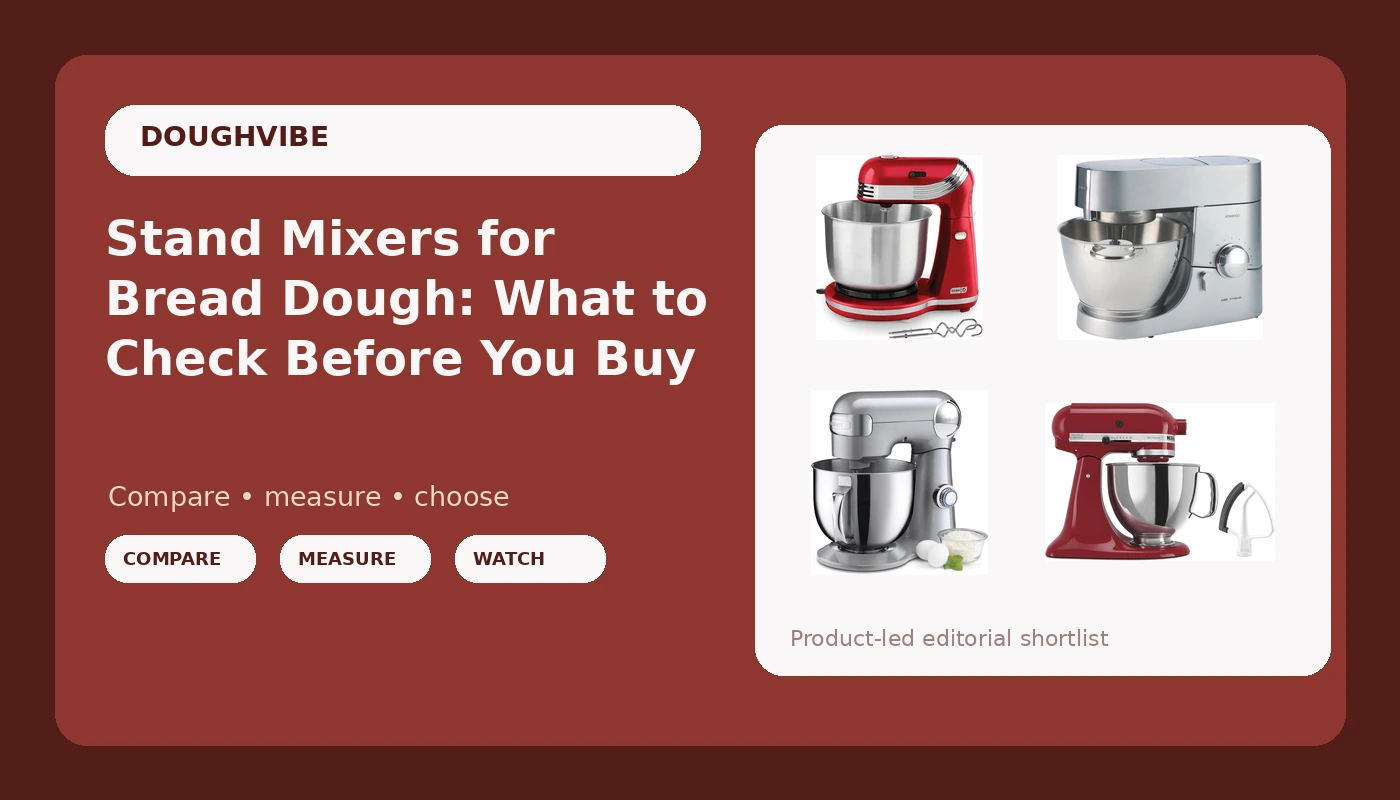
Walk into any appliance aisle and every stand mixer looks capable. The spec sheets talk about quarts and speeds, and almost none of them mention the thing that decides whether you keep the mixer or quietly resent it: how it behaves once the dough gets stiff. If bread is the reason you are shopping, that is the whole question. Stand mixers for bread dough live or die on motor capability, drivetrain design, and bowl geometry, and those are the details a marketing paragraph will not hand you. The four machines below are four different answers to the same problem, from a compact three-quart mixer built for small batches of batter to a five-quart model with a documented 800-watt motor aimed at heavy dough. Here is what each one is set up to do, where the trade-offs sit, and how to choose without paying for capability you will never use.
Related: Kneading Bread Dough by Hand vs a Stand Mixer →
Quick answer
For most home kitchens the decision comes down to what you mix most often. A five-quart tilt-head with a broad attachment ecosystem, such as the KitchenAid Artisan bundle, covers cakes, cookies, and moderate bread duty in one machine. If stiff dough is the priority, a mixer with a documented high-output motor and variable speed control, like the Kenwood Chef Titanium, is the more sensible starting point. The Cuisinart SM-50 sits in the middle with a larger 5.5-quart bowl and a full set of mixing tools included, and the Dash Everyday is a compact 3-quart option for small batches and short counters rather than for heavy kneading.
Four useful options
| Model | Best fit | What stands out |
|---|---|---|
| KitchenAid Artisan Bundle, 5-Qt Tilt-Head Stand Mixer w/Flex Edge Beater | All-purpose home baking | 5-quart tilt-head format with a Flex Edge beater included |
| Kenwood Chef Titanium Kitchen Machine | Dough-heavy kitchens | 800W motor with electronic variable speed control |
| Cuisinart Stand Mixer SM-50BCNAS | Large-batch mixing on a mid-range budget | 5.5-quart bowl plus whisk, paddle, dough hook, and splash guard |
| Dash Everyday Stand Mixer | Small kitchens and small batches | Compact 3-quart tilt-head design with 6 speeds |
The all-rounder: KitchenAid Artisan Bundle, 5-Qt Tilt-Head Stand Mixer w/Flex Edge Beater
The tilt-head layout is the reason this style of mixer dominates home kitchens: the head tips back and you get both hands into the bowl without lifting anything heavy. The trade-off is mechanical. On a tilt head, the head itself is the moving part, so under a stiff dough load the whole assembly is working against the hinge rather than sitting in a fixed casting. That does not make it a bad mixer. It makes it a mixer where dough is the demanding job and creaming butter, whipping cream, and folding cookie dough are the easy ones. The 5-quart bowl is generous for cakes and moderate for bread, and the value in a bundle like this one sits in the beater you would otherwise buy separately.
The motor-first pick: Kenwood Chef Titanium Kitchen Machine
This is the one where the published spec actually tells you something useful. An 800-watt motor is a different class of machine from a compact mixer, and electronic variable speed control means you can dial a slow, steady speed for incorporating flour instead of stepping through fixed gears. Slow and steady is what dough wants: a mixer that spins a stiff dough too fast heats it and stresses the drivetrain, while a mixer that can crawl gives the gluten time to develop. The trade-offs are practical rather than mechanical. A machine built around motor output tends to be heavier and louder than a tilt-head, and it takes up more counter space, which matters if you store it rather than leave it out.
The mid-range kneader: Cuisinart Stand Mixer, 12 Speeds, 5.5-Quart Mixing Bowl
The interesting number here is not the speed count, it is the bowl. At 5.5 quarts this is the largest capacity in this group, and a bigger bowl changes what a mixer can do: more headroom for dough to climb the hook, more room to add flour without a cloud of it leaving the bowl, and a splash guard with a pour spout so you can stream liquid in while the mixer runs. The included dough hook is the difference between a mixer that is theoretically bread-capable and one that is ready for a first loaf out of the box. Twelve speeds is more granularity than most bakers need, but granularity is not a downside. The honest trade-off is that a large bowl and a full tool set do not automatically mean heavy-duty dough capability, so treat this as a capable all-purpose mixer rather than a bakery machine.
The compact choice: Dash Everyday Stand Mixer
A 3-quart bowl tells you the intended batch size before you read anything else. This is a mixer for one cake, one batch of cookies, one bowl of whipped cream, or a single small loaf, and it earns its place in apartments, small kitchens, and households where a full-size mixer would live in a closet. The compact tilt-head format keeps it light enough to move, and stainless steel is the right bowl material at any size. Where it does not compete is stiff, high-hydration dough at volume. A compact machine has a compact motor, and pushing it through repeated heavy kneading is how small mixers end up smelling hot. Buy it for the recipes you actually make on a Tuesday, not for the sourdough phase you might start next year.
Prices and availability can change. Check the retailer listing for current details before you buy.
What actually decides bread performance
Bowl size is the most visible number on the box and the least useful one for predicting how a mixer handles dough. The bowl is a container; the motor and drivetrain are the machine. Wattage is a measure of power draw, not of torque at the hook, which is why two mixers with similar wattage ratings can behave completely differently once a stiff dough starts resisting. What separates them is gearing, the strength of the moving parts, and how the speed control delivers power at low rpm. A mixer that holds a slow, steady speed under load develops dough. A mixer that bogs down and surges is fighting the dough, and the friction goes into heat rather than gluten.
There is also a sensory signal worth trusting. If a mixer's motor smells hot after ten minutes of kneading, the machine is telling you the job is beyond it. That is not a defect in the mixer so much as a mismatch between the mixer and the task, and repeated exposure to that heat is what shortens the life of the machine.
Tilt head, lift bowl, and the geometry of dough
Tilt-head mixers are convenient: the head tips back, the bowl stays put, and loading and scraping are easy. The hinge, though, is a moving joint, and heavy dough puts load on it. Lift-bowl designs raise the bowl into a fixed head, which is a sturdier arrangement for stiff dough, at the cost of needing vertical clearance to raise the bowl and a bit more effort to load. Neither design is wrong. Tilt head is the friendlier everyday format; lift bowl is the format that takes repeated heavy work with less drama.
Capacity deserves its own warning. A bowl rated at five quarts is not a bowl designed to hold five quarts of dough. Dough needs room to move, to climb the hook, and to expand, and a bowl packed to the top will stall even a strong motor. Treat the rated capacity as the outer limit of the container, not as a dough target, and keep your typical batch comfortably under it.
- Decide whether bread is a real habit or an occasional project. That single answer eliminates half the market.
- Estimate your largest regular batch by dough weight, then choose a bowl with room above that number.
- Check whether the motor output and speed control are published, because an unstated spec is usually not a strength.
- Choose tilt head for convenience and lift bowl for repeated heavy dough, based on how often you knead.
- Confirm which tools ship in the box, since a dough hook that is not included is an extra purchase.
Practical guidance before you buy
- Weigh your flour instead of scooping it, because an over-floured dough is the most common reason a capable mixer seems weak.
- Start dough on the lowest speed and let the hook do the work rather than rushing development at high speed.
- Give the motor a rest between batches if the housing gets warm, which costs nothing and extends the machine's life.
- Match the mixer to the batch you make weekly, not to the largest batch you might make once a year.
- Check what attachments the platform supports if you want the mixer to do more than mix, since the tool ecosystem often outlasts the mixer itself.
Which option should you choose?
Choose the KitchenAid Artisan Bundle, 5-Qt Tilt-Head Stand Mixer w/Flex Edge Beater when you want one machine for cakes, cookies, frosting, and moderate bread duty, and you value the tilt-head convenience and the Flex Edge beater that comes with the bundle. Choose the Kenwood Chef Titanium Kitchen Machine when dough is the point and you want a documented 800W motor with electronic variable speed control driving a 5-quart stainless steel bowl. Choose the Cuisinart Stand Mixer, 12 Speeds, 5.5-Quart Mixing Bowl when you want the largest bowl in this group plus a whisk, paddle, dough hook, and splash guard included from the start. Choose the Dash Everyday Stand Mixer when your batches are small, your counter is short, and a 3-quart bowl with 6 speeds covers the baking you actually do.
A caveat worth stating plainly: motor capability and drivetrain design matter more than any number on a spec sheet, and none of those qualities can be judged from a bowl size or a speed count alone. If your baking is dough-heavy at volume, a compact or all-purpose mixer will eventually feel like the wrong tool no matter how well it performs on batter.
The bottom line
The right stand mixer is the one matched to the dough you make most often. If you bake bread seriously and often, prioritize published motor output, slow-speed control, and a bowl with room for the dough to move, which points toward the Kenwood Chef Titanium. If you want a single mixer for a broad home baking rotation, the KitchenAid Artisan bundle covers that ground, the Cuisinart SM-50 gives you the biggest bowl and a complete tool set, and the Dash Everyday is a sensible compact machine for small kitchens and small batches. Whichever you pick, the test that matters is not how it whips cream. It is what happens on the fifth loaf.